Showing posts with label weight loss. Show all posts

Saturday, March 16, 2013

Blog<Weight Loss>

I promised this like 2 months ago, but some stuff came up that is taking up most of my weekend time (which I promise to blog about at a TBD date). So, as I mentioned in this post, I am trying to lose weight again. And I've got some other goals as well, mostly so that I have more motivation than just staring at the scale every week, and (more importantly) because who the fuck cares how much a person weighs? I want to look and feel good.

Anyway, here's what I've been up to for the past 2 and a half months. You can read some of my previous posts on the subject if you are curious about the reason for the stuff I'm doing. Looking back, I still agree with almost all of it. Now is probably a good time to mention that I am not a certified nutritionist, or personal trainer, or medical doctor, or workout robot, or whatever. So please consult your physician before attempting anything you read on the internet. Or don't, but just remember that you're doing it at your own risk.

Diet
I calculated my BMR at around 2200 calories. I try to eat that much every day. This will change as I lose more weight. I used the myFitnessPal app for the iPhone to track my meals for about 4 weeks until I had a good understanding of what I was eating every day. Now it mostly goes unused, but it was a great tool for that first month.

There's a funny thing about counting your calories and macro nutrients (Protein, Fat, Carbs). In order to stay under your magic calorie count for the day and still feel satisfied after a meal, you have to eat healthier food. The crap you get at McDonalds or Taco Bell is high in calories and low in satiety. So, in order to feel like I was eating enough, I switched to lean meat, salad, homemade sandwiches, broth-based soups, yogurt, and basically anything that you can find on the outer walls of the grocery story. This is where they put the healthy stuff. They put the processed stuff in the middle because it doesn't go bad and they don't have to switch it out as much. At this point, I can basically eat anything in my fridge or pantry without feeling bad about it because it's all pretty healthy (I am still conscious of the proper portion size though).

I love to grill, so I'll cook up 3-4 chicken breasts at a time and eat it for the next few days. Anyway, I feel like I get to eat until I'm full and that's about the perfect amount of calories. I have a pretty boring diet, but that's fine with me.

I also cut out sodas and I only occasionally drink caffeine (twice a week). This has forced me to drink more water, which has also forced me to get up and walk around more at work, either to refill my water bottle or to use the restroom.

Weight Training
Every weight loss plan needs to incorporate resistance training of some sort. It reduces the amount of muscle loss that comes with being on a calorie deficit You don't want to lose muscle because it's what burns fat, and by doing resistance training, you're telling your body "Hey, we need these things. This isn't a fuel source." Pretty simple.

As before, I follow (a modified version of) the Stronglifts 5x5 plan, which is 3 workouts a week. Squats every workout, and alternating bench press/barbell row, and overhead press/dead lift each workout. My modification is related to my running goals. Basically, I was following the SL5x5 program at the recommended pace, which is to add 5 lbs to each exercise every workout. The problem, is that I run between the weight days so I don't get the full 48 hours of recovery time. This lead to patellar tendon pain at around 75 lbs on the squat and back pain at around 100 lbs (with the patellar tendon pain just getting worse each increase.)

I'm just doing the weight training to accelerate the weight loss, the running is my real goal, so I decided to make a change. I first dropped the weight for all the lifts and I completely dropped all the weight for squats (just the 45 lb bar). Then I decided to only increase the weight by 5 lbs every other workout for each exercise. Basically, I'm increasing at half the recommended speed. It seems to be working well so far. I don't have any back pain anymore (improving my squat and dead lift technique is helping here), and for the past week my patellar tendon has been pain-free as well, which is huge because I was afraid I'd have to stop the running entirely to let it heal.

I added bicep curls because I'm vain (and because a bigger bicep keeps my iPhone arm band in place when I'm running). I increase the weight by 2.5 lbs each week, but I'll be switching over to pullups as soon as I can do more than 3 in a row. :)

I also decided to start doing a pre-workout/warm up consisting of planks, side planks, back crunches (I don't know what these are really called), and stretching/warm up type stuff. I'm now at 1 minute on planks, 45 seconds on each side for side planks, and 20 back crunches, which I do mostly just to warm up my back muscles. I do all this 3 times in about 8 minutes, and I stretch during the time that I'm not doing planks. The planks have helped immensely with my core strength. I started at 45 seconds normal planks and 30 seconds side planks, and I increase everything by 5 seconds each week. When I'm done with all this (takes about 20-25 minutes, I head to the garage for the barbell lifts, completely warmed up.

Overall, I feel a lot stronger. My muscles are more defined. And I no longer cringe when looking at myself in the mirror. I'll keep increasing the weight until I plateau either from the calorie deficit or from pain or injury. Hopefully the former.

Running
The inspiration for today's post. I ran a personal best 6.75 miles this morning. It was slow as hell, but it's still better than I've ever done. I did 5 miles barefoot, and the rest in my Luna sandals.

I outlined some of my running goals in an earlier post, but I basically wanted to be able to run a 10k in mid-April. So my training plan has been as follows. Twice during the week, I try to run about 3-4 miles, focusing on not wearing out the soles of my feet, and lately, focusing on increased pace. On Saturday, I focus on increasing my distance (regardless of pace). My initial plan was to increase by .25 miles each week, but I've actually been increasing somewhere around .5 miles.

It took a long time (I was at around 3 miles max distance at the beginning of the year), but I'm ecstatic with the results so far. I've already surpassed the distance needed for the 10k, which was a big mental barrier to break through. Now, I feel like with training (and hopefully about 20-30 additional lbs of weight loss), I might actually be able to do a half marathon at the end of this year or early next year.

One big thing that today's run taught me is that I should probably start carrying water with me. I'm thinking about getting a camelbak or some kind of belt, because I already feel like I carry too much crap in my hands (my sandals). My thought is to just strap it to my body somewhere and not worry about it until I'm thirsty. There might even be a pocket or something to store my sandals while I'm barefoot.

Putting it all Together
So, here's my schedule in condensed form:
  • Monday - Rest Day (And sometimes a cheat day on the diet. Nobody's perfect.)
  • Tuesday - Run 3-4 miles. Focus on pace and technique.
  • Wednesday - Lift. Plank workout and barbell exercises.
  • Thursday - Run 3-4 miles. Focus on pace and technique.
  • Friday - Lift. Plank workout and barbell exercises.
  • Saturday - Long run. Increase distance .25 - .5 miles. 
  • Sunday - Lift. Plank workout and barbell exercises. 
Eat 2200 calories a day. I try to eat as much protein as I can and the rest I split between carbs and fat, but I'm not fanatical about it.

Results so Far
It's been about 2.5 months since I started the lifting and diet, and I've lost almost 20 lbs. This was my weight loss goal for the 10k, and I've almost achieved it (a month early.) I'll keep chugging along and occasionally adjust stuff, but I'm pretty happy with the results so far. 

If it ain't broke, don't fix it. 

Talk to you next time.

Tuesday, September 7, 2010

Blog<Losing Weight> 8 Months Later

Changing It Up

In the last post about my weight loss, I talked a little about my new goals. I had just just lost 60 lbs over the previous 7 and a half months, and I was still in the mindset of measuring success by the number on the scale.

Fast forward a few weeks, and I've finally started to let myself stray from the strict dieting, long cardio, and boring resistance training that got me to this point. That's not to say that I'm not still watching what I eat and exercising, but I'm a little more relaxed about it. I'm starting to ease myself into more of a maintenance mode (with a little bit of weight loss along the way).

For most of the year, I was doing 4 days of elliptical per week (55-70 minutes 3 times and 80-120 minutes on Saturday). And on 2 days, I was lifting weights for about 45-60 minutes. I have to say that I'm happy with the results, but after 7 and a half months you start getting sick of it.

So I started to think about how to minimize my time in the gym.

The first change I made was to replace some of the elliptical days with running. I started off replacing 2 days, but that has recently grown to 3. I still do my 2 weight-lifting days, but I've been trying to switch up the exercises I do from workout to workout. And finally, I replaced the last elliptical workout with a HIIT workout and added another HIIT workout on what was previously my rest day.

Normally I wouldn't recommend 7 workouts in 7 days because it's usually a good idea to have at least one day a week to let your body recover. My take is that life normally intrudes and forces a day (or more) off anyway, so if I can't work out on a given day, so be it. Because of this, I've only actually completed the 7 workouts in 7 days once in the past month.

The new schedule means less time in the gym and no more mindless cardio. The HIIT workouts hurt pretty bad but you can't say they're boring, and they only take 40 minutes each (including warm-up and cool-down). The three running days probably add up to 45-60 minutes total since I'm still a beginner. And, as a bonus, running is actually fun. My weight-lifting days are still a drain on my motivation, and they still take 45-60 minutes each, but they're important with all the potentially-muscle-burning cardio that I'm doing.

As of this morning, I'm down to 198 lbs, which is what I weighed near the end of my freshman year in college. 8 lbs in 6 weeks is significantly less than the 2 lbs per week I was losing before, but the important thing is that I've mostly had fun doing it.

8 lbs also happens to be the half-way point for my end-of-year goal to slim down to 190. I normally don't like counting my chickens before they hatch, but I'm pretty sure this one's in the bag.

Sunday, July 25, 2010

Blog<Running> 2 Months Later

I've been running for about 2 months now, so I figured I'd share another update on the little successes (and failures) I've had along the way.

Distance

The distance is coming along slowly. I started with a .5 mile runs, and after about 3 or 4 weeks increased that to 1 mile. Since then, I've generally been trying to stick to the 10% rule (increase distance by no more than 10% every week.) Yesterday, I ran 1.3 miles, so I'm on track to break 2 miles in about a month and a half.

I have to say that the progress at this point is almost unbearably slow, but it's not just the arbitrariness (arbitrarity?) of the 10% rule that I feel is holding me back. Once I reach the 1/2 to 3/4 mile mark I kind of hit a wall where I'm suddenly not having much fun anymore. Part of it is the Dallas summer heat, and part of it is the fact that I'm not a morning person (but I have to get up early to beat the heat). And another part is that I'm just not physically conditioned for running yet. I don't feel in sync when I get to this point, like I can feel all 205 lbs of myself at every step, like some self-conscious, lumbering giant. A giraffe with lead boots. It's a big difference from the stealthy ninja feeling I have at the beginning, and I really have to concentrate to keep it smooth and relaxed.

And now I'm talking about the things I feel for the entire duration of my runs, but I'd rather not be self-conscious the entire time, especially if I ever get the point where I can run for more than 20 minutes. If it's anything like swimming, there's a point where your brain turns off while your body goes through the motions. It's kind of relaxing, almost meditative. If it exists for running, I hope I get there soon.

Barefoot Running

A couple of weeks ago, I decided to take off the VFF's and go for a real barefoot run. I mentioned it a couple of posts ago, as a way to help improve your form. Well, I tried my hand (foot?) at it a one more time since then, and it was a total disaster.

First, I made the mistake of trying it after work one day. The temperature outside was about 95 degrees, and the temperature of the sidewalk was probably 10-15 degrees hotter than that. Second, I made the mistake of only running on the sidewalk (which is a way rougher surface than the road, which I had stuck to on my previous barefoot run). And my last mistake was that I naively thought I could run the same distance as before without any problems, despite the difference in my environment.

I ran about .3 miles when I started getting "hot spots" on the balls of my feet. I pushed through it a little bit, which in retrospect should have been my sign to stop. I ran a little further when I noticed the ball of my left foot felt like it had some kind of air pocket stuck to it. I could feel it squishing a little when I landed on it. Actually, forget that. Sure, there was certainly a squishing feeling, but it was accompanied by its good friend, pain, who managed to deliver a much more intense sensation. So I stopped after only making it .4 miles, and hobbled the short distance back to my house.

The heat and friction of the sidewalk had created a blister from my 2nd to 4th metatarsal on the ball of my left foot. It was like the skin on the sole of my foot had separated from the flesh underneath, and the resulting pocket had been filled with some clear fluid. I made the mistake of popping it and then putting hydrogen peroxide on it. The peroxide actually went inside the blister where it created a layer of tiny popping bubbles, which slowly expanded to fill the void. I could have swore my foot was on fire if not for the fact that there was no accompanying seared flesh smell.

It took 3 days to heal to the point where I could walk normally again. Needless to say, I probably won't be going for any more barefoot runs after work.

Maybe in November.

Improved Form

It's crazy to look back to when I first started out with the forefoot style of running and compare my form then and now. Here's a small list of some of the things I've learned:
  • It's okay to let your heel touch the ground. Actually, the sooner it touches the ground the better, as it means you are spreading the impact across the entire surface area of your foot, and you won't put as much strain on your calf and achilles tendon. I would venture a guess that it's probably better to land on the entire foot simultaneously, but it's really hard to do without hitting heel first.
  • Don't spring off the ground with your toes. This causes a lot of stress (pain) on the top of the foot and in the ankle, and introduces an unwanted up and down motion. Instead, lift the toe and heel off the ground simultaneously. This is actually a pretty difficult motion to learn, and the slight pain in the top of my foot means I'm not good enough at it yet.
  • Focus on moving forward, not up and down. Vertical movement wastes energy. Not only that, but it adds extra stress to your foot landing. Normally, when something starts hurting (like my shins) it can be immediately remedied by minimizing my up and down motion. Bent knees help a lot here. Bend them to the point that it feels almost like you're sitting down.
  • Fast cadence with shorter strides is better. 180 steps per minute (or quicker) is recommended. With my long legs, I find this really difficult, but it does seem to keep my form smoother.
  • Don't try to control the natural inward roll of your foot. As someone with flat feet, I tend to over-pronate. For a while, I tried tensing up my foot and ankle muscles to prevent my foot from rolling inward. This just caused horrible ankle and foot pain, and gave me a bruise on the sole where I was landing. By letting my foot land naturally, I quickly ended the pain.
  • Along the lines of the previous point, don't fight through pain. Pain is there to tell you that you are doing something wrong. Continuing to repeat the painful motion will only make it worse and lead to injury. If it feels like something in your joints or bones, or like your muscle is about to give out, then either something is off in your form (you should change it up so the pain goes away), or you are doing more than your body is ready for (you should stop and build up gradually).
  • Running works your abs like crazy. A few weeks ago, I noticed that I had a mild stomach ache after a run. I thought maybe it was just a cramp, or maybe gas. When it persisted after each run, I thought that maybe my body just wasn't made for running and that my stomach was taking some kind of revenge for shrinking it down to a normal size. Well, it turns out that running with good posture and minimal upper body movement means your core has to do some stabilization, and as a result it gets a great workout. On my last run, I pressed a few fingers to my stomach and felt an almost constant low intensity flex, with a stronger flex on each step. Whatever thoughts I had of moving my ab days to coincide with my running days have now been thrown out the window.
What's next?

As I mentioned in the last post, I want to be able to run 5 miles by the end of the year. If I can keep increasing the distance by 10% every week, I'll be doing 5 mile runs in 16 weeks. However, if my recent running experience has taught me anything, progress will probably be a little slower. In any case there are 23 more weeks left this year, which seems like a reasonable time frame. Feeling motivated!

Saturday, July 17, 2010

Blog<Losing Weight> Goal Achieved!

Success!

Last week I talked about how close I was to achieving my weight loss goal. I normally do my official weigh-ins on Sunday morning, but I was so excited at the prospect of finally getting there, that I couldn't wait. My weight this morning was 205.6 lbs. That's a loss of a little over 60 lbs since January! Here are a few fun facts.
  • Total weight lost: 60 lbs
  • Time taken: 6 and a half months
  • Avg. weight lost per week: 2.14 lbs
  • Total calories burned: 210,000
  • Avg. calories burned per week: 7500
  • Change in BMI: 32.38 - 25.07 = 7.31
  • Change in BMR: 2505 - 2131 = 374 cal
Before and After

My reason for trying to lose weight was because I looked in the mirror and didn't like what I saw. In January, after over-eating at Thanksgiving, Christmas, the New Year, all of that Winter-time hibernation-mode eating, piled on top of a few years of not getting enough exercise and eating fast food all the time... after all that, I looked in the mirror and realized I needed to make a change.

Half a year ago, I used to start breathing heavily while walking up stairs. I used to get a rash from my thighs rubbing together. My feet used to get sore after standing for half an hour. I used to get acid reflux at night. The Texas heat used to bother me more. I used to struggle to lift heavy objects. I couldn't run a mile if my life depended on it. I used to depend on caffeine to get me through the day. The only positive thing about being so overweight and out of shape was that my clothes fit better than they do now.

That's not to say that the past 6 months have been peachy. I've suffered nearly every non-serious injury/malady you can think of while exercising and dieting my way into shape: shin splints, dehydration, friction blisters, runner's trots, pulled muscles, exercise-induced nausea, hyper-extended knees, crazy foot/ankle pain, hunger, caffeine-withdrawal headaches, and more sore joints than you can shake a stick at. But despite the setbacks and minor (sometimes major) discomfort, it was all worth it to get to where I am today.

Now I look in the mirror, and I don't cringe. I'm not completely happy with how I look (yet), but I love how I feel.

The Pictures

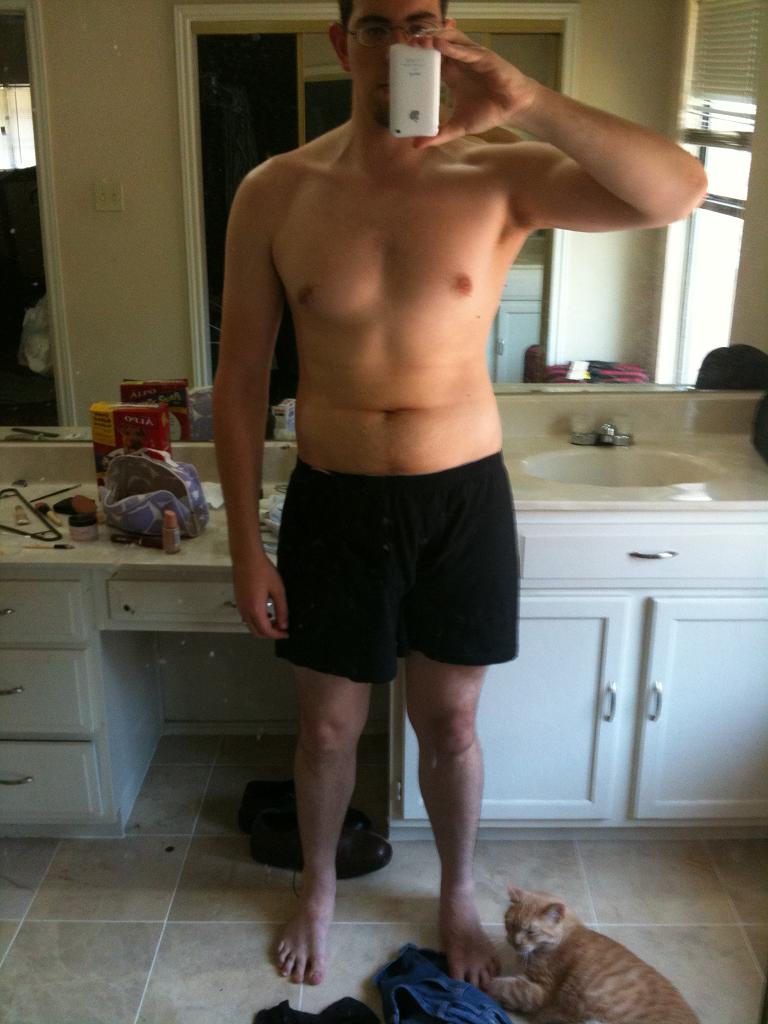
Before I started my weight loss plan, I decided to take some pictures so that I could compare my old flabby body with my new toned and firm one. It is with great embarrassment that I am now posting these pictures. Hopefully you don't need me to tell you that "old and flabby" is on the left, and "toned and firm" on the right, but I just did... so there.

Body - Front

Body - Side

Face - Front

Face - Side


What's Next?

As I mentioned earlier, I feel great, but I'm still not completely satisfied with how I look. I still have a roll of fat around my belly that I'd like to get rid of, and I'll be damned if I can't melt it off by the end of the year.

For now, the diet and exercise have become such an integral part of my life that I probably won't change much from what I've been doing. I plan on focusing more on running and generally trying to have fun during my workouts so that I can eventually transition into some kind of weight-maintenance mode.

So, my new goals for second half of the year are not quite as extreme as the first half:
  • Get down to 190 lbs (16 lbs over the next 24 weeks should be easy)
  • Be able to run 5 miles

That's it for now. See you next time!

Saturday, July 10, 2010

Blog<Random> Writing, Weight Loss, and Running Barefoot

Just some stuff I've been thinking about.

Writing

I'm a little embarrassed by the story I posted yesterday. There's a kind of self-conscious debilitation that usually prevents me from writing as soon as the idea pops into my head. Like I'm a hack, trying to keep my secret from everyone. It's part of the reason for this post, to push the story down a little, off the front page. At least now people will have to click a link or scroll down to find it.

But, I liked the idea, and if I didn't write it down, it would be rotting in my brain. And if I didn't post it here, it would be rotting on my hard drive. Now it can rot on the internet.

Your welcome, the internet.

Personal embarrassment aside, please fire away with your critiques. I'd like to get better, so don't hold back. After writing this one, I've got a few ideas along the same lines (immortality, fear of dying, existence, etc...), and I'd like to not feel quite as embarrassed the next time.

Weight Loss

I'm a week or two away from my goal. If it weren't for the 4th of July weekend (gained about 3 lbs!), I'd probably be there already. But I knew I'd have to work off all the food before I ate it, so it wasn't really a surprise. Once you get comfortable with your diet and exercise plan, the only thing that really surprises you is when you lose more than you thought you would. There's always an explanation for weight gain.

On the motivation front, the past couple of weeks have been difficult to keep a schedule. The week before the 4th of July, I only got 3 workouts in. Then, we got back from the vacation on Tuesday, so I only had 3 days this past week. On Thursday, I almost skipped my resistance training (I hate weight lifting.) I was halfway to my car before I made myself turn around and go back to the gym.

Hopefully this week I'll get a solid 5 days in (plus a run on Saturday), because I'll be going on vacation again the following week. It would be nice to put this goal to bed by then.

Running Barefoot

Last week, I went for a run in my Vibrams. I could feel some slight shin splints pain almost immediately. I ran for about 1/4 of a mile and decided to start changing up my form to see if it would make a difference.

I bent my knees more (kind of like sitting in a high chair, with your feet hanging down to touch the ground.) I also focused on moving forward instead of springing up and down. I noticed an improvement right away. The shin pain didn't go away, but I could tell that I wasn't making it any worse. I kept up this new form for about another half mile before it started slipping. The remaining 1/4 mile back to the house was a battle of concentration.

The experience of changing my form and feeling relief was pretty exciting. I opened my favorite web browser and found a pretty awesome site about barefoot running. The founder of that site, a caveman-looking dude called Barefoot Ken Bob, has run over 75(!) marathons completely barefoot. He recommends not wearing minimal shoes (like the Vibrams) when you are just starting out because, even though they're thin, the sole keeps your foot from feeling the ground and still allows you to pound a little.

He was right! This morning, I decided to do half of my mile run completely barefoot. I could tell immediately that my form in the Vibrams wasn't as smooth or low-impact as I thought. I know that I've gushed about the feeling you get in the Vibrams before, but it really doesn't compare to actually going barefoot.

I'll probably write more about it next week, but if you are thinking about taking up running in minimal footwear, I highly recommend trying it completely barefoot. Just remember that the goal is not to push through any pain you feel, it's to avoid pain. And you can only avoid pain by improving your form and by slowly building up your endurance. So, don't go further than your feet are ready for. 1/2 a mile was my limit today.

Tuesday, June 22, 2010

Blog<Losing Weight> Addendum

I left out some stuff in my last post because it was already ridiculously long. I'm just going to throw a few more things out there for you to think about in case you weren't overloaded with data the first time.

The Mythical Fat Burning Zone

Look at any cardio machine at your gym and you'll see a little sticker that shows which heart rate ranges are better for... whatever reason you have to use their machine. There's one that's called "Fat Burning" that I'm sure you've seen and thought "hm... I wonder if I'll lose more weight if I try to stay in that zone?" It's usually between 50% & 60% of your maximum heart rate (the elliptical machines at my gym have it between 90 and 120 bpm).

In short, this zone is really only needed by ultra-endurance athletes, and unless 60% of your max heart rate is as intense as you can go, it's pretty terrible for weight loss. But before I go into that, it's important to look at what energy sources your body uses while exercising.

Your body require a specific molecule, ATP, in order to fuel muscle contraction. ATP is a very short term fuel source, and is only stored in tiny quantities (seconds worth at any given time), so it must be constantly created from other sources like fat, carbs, or protein. Protein does not contribute very much while exercising, so for the purposes of this post, I'm going to skip it.

At around 50% of your max heart rate, fat supplies most of the fuel for ATP creation, which is why you see the unfortunate "fat burning zone" label on the machines at the gym. Fat is a very efficient fuel source, but it takes a while to convert it to ATP. The good thing (or bad thing in the case of losing weight) is that you have a ton of it stored in your body. It's a slow burning fuel stored in a big tank. If fat were a non-renewable fossil fuel, it would be coal.

At around 60-70% of your max hear rate, you will start using more carbs as a fuel source than fat. That's not to say that you stop metabolizing fat (in fact, when your heart rate increases, you will metabolize fat at a faster rate), it's just that you will start burning a higher percentage of calories from carbs. Carbs are much more efficient to convert to ATP than fat. If fat is coal in our analogy, then carbs are jet fuel.

But why do we care about burning a bunch of calories from carbs when we could just burn fat? Sure, higher intensities might burn slightly more fat, but is it worth it for me to expend the extra effort?

The reason is pretty simple. You have a limited store of carbs that your body can use while exercising (about 1 to 2 hours worth depending on intensity). After you work out, and especially while you are sleeping, your body has to refill its store of carbs so that it can be ready for whatever else you throw at it. To refill the store, your body needs to convert from an existing energy source, your body fat. So while you are sleeping, your body is busy converting your fat onto carbs to replace the ones you used while you were working out.

So, the next time you're working out, decide what you'd rather do
  1. Pay heed to the "fat zone" label and burn maybe 150-300 calories in an hour, burning fat only while you are working out.
  2. Increase the intensity. Burn more carbs than fat as a fuel source, and two to three times as many total calories, and then burn fat later while you sleep.
So why did I mention the thing about super-endurance athletes? Well, you can literally workout for several hours (days even) provided that you have enough fat in your body. If you keep your heart rate at about 50%-60% you can keep going until your fat stores run out. There are ultra-marathon races that are 100 miles long and start and end with the sun down. In this scenario, wouldn't it be better to burn mostly fat?

Your carb stores on the other hand only last about 1 to 2 hours, after which, you must go back down to a lower intensity to burn fat (or, you can replenish carbs by eating/drinking while you're working out, but then you're burning calories directly from your food and not the calories stored in your body).

I don't know about you, but spending more than 2 hours at the gym doesn't sound very appealing. The pure and simple fact is that you will burn the same amount of fat regardless of the type of energy you use while exercising. Fat loss is only related to the amount of calories you burn, and you will burn way more calories by kicking up the intensity than by sticking in the so called "fat burning zone".

HIIT

The processes above are specific to a certain type of exercise. They require the presence of oxygen, supplied by your blood, to convert carbs or fat into ATP. This process is called aerobic respiration. However, once your intensity increases to a certain level, your muscles will no longer be able to get oxygen fast enough to create the ATP to keep moving.

When this happens, the carbs stored in your muscles will be converted to ATP without the presence of oxygen, in a process called anaerobic respiration. Anaerobic respiration is highly inefficient compared to aerobic respiration. It only produces 1/20 the amount of ATP from the same amount of carbohydrates, and it also creates lactic acid as a byproduct. As lactic acid builds up, your muscles will start to burn, become fatigued, and eventually you will become physically unable to continue at such a high intensity.

There is a specific type of training that takes advantage of this process, called High Intensity Interval Training (HIIT). The premise behind HIIT is that, by exercising anaerobically, you will metabolize carbs more quickly than via normal aerobic exercise. It usually consists of a period of very high intensity exercise (90-100% max heart rate) lasting anywhere from 30-90 seconds. This is followed by a period of low intensity exercise for the same duration or until your heart rate drops below a certain threshold (70%-ish of max). You then repeat the intervals anywhere from 8-12 times.

The appeal of this type of exercise is that, through the inefficient process of anaerobic respiration, it allows you to burn through a large chunk of your carb store in as little as 20 minutes. Because of the lactic acid build up, it also shouldn't be performed without at least 48 hours to recover, so for those MWF people, who have limited time to spend at the gym, it can be a great way to burn a ton of calories with a minimal time investment.

HIIT isn't for everyone though. It's extremely physically demanding. You shouldn't even attempt it unless you have a good amount of endurance built up from a regular exercise plan. The goal is to go as hard as you possibly can for each of the high intensity intervals, until you literally can't continue (due to lactic acid buildup). It's a lot higher impact than normal aerobic exercise, and you have to be able to maintain a certain level of control to avoid injury (falling off the machine). If you do it right, by the time you finish your last interval, you'll be close to passing out or puking or both, and you'll barely be able to stand on legs that feel like rubber. So if that doesn't appeal to you, then it's probably not for you.

The other major reason not to attempt HIIT is if you aren't limited by time. You will be able to burn more calories through normal aerobic workouts, since you aren't limited by the 48 hour recovery period.


So hopefully I was able to shed some light on some of the processes that occur during exercise and how they relate to your weight loss goals. I'm sure I still have a few nuggets on the subject that you can expect in a future update.

Sunday, June 20, 2010

Blog<Losing Weight>

I am a person who believes in math, science, and logic. I hate it when someone tells me that the best way to lose weight is cardiovascular exercise, lifting weights, and diet. And then they don't spend anymore time explaining why. For me, the derivation is more important than the proof itself (forgive the kludgey math metaphor), otherwise it's hard for me to buy in.

So let me start off by telling you that the best way to lose weight is cardiovascular exercise, lifting weights, and diet.

If I do a good job explaining it, the rest of this post will tell you why.

When I got really serious about losing weight earlier this year, I did a bunch of research. I knew it would take a long time to reach my goal (losing 60 lbs), but I wanted to make it as efficient and quick as possible. The first thing I found was really obvious:

Calories Burned - Calories Consumed = Calorie Deficit = Weight Loss

That is weight loss boiled down to a simple formula. The higher your calorie deficit, the more weight you will lose. To throw another formula into the mix, 3500 calories is equal to 1 lb of body fat. So if you want to lose 1 lb of fat a week, you need to burn 500 calories more than you eat every day. The one simple rule I can give is this: it is impossible to lose weight without creating a calorie deficit.

The Calories Burned part of the equation can be further split into BMR + Calories Burned during Exercise. So the equation now looks like this:

BMR + Burned Calories due to Exercise - Calories Consumed = Calorie Deficit

Everything I researched pointed to this "magic" formula. So I took a closer look at the 3 things on the left and tried to figure out how to make it as efficient as possible.

BMR

BMR, or Basal Metabolic Rate is something you don't have any control over. It takes into account your age, sex, height, and weight. It is a measure of how many calories your body burns just to keep itself running. There is a pretty good BMR calculator here (everyone is different, so no BMR calculation is going to be perfect, but it will get you in the ballpark.)

I am a 6'4", 27 year old male. When I first started trying to lose weight, I was 266 lbs and my BMR was 2505 calories per day. Basically, if I was in a coma, I would need 2500 calories to maintain my weight. As a comparison, I redid the calculation with my goal weight of 206 lbs and I got 2131 calories per day. So clearly your weight plays a big role in your BMR.

Also, your BMR seems to be a lot more important than exercise in the "calories burned" part of the formula. I mean according to the formula, if I ate nothing and never exercised, I would lose 2/3 lbs every day. It would seem that increasing your BMR would be way more important than exercising more or eating less. It would be pretty difficult to burn 2500 calories in a workout. But you can't change your BMR, so why am I even talking about it?

Well, it turns out that I was lying a little bit when I said you're BMR is a fixed value. There is a different parameter that you have some control over (that isn't taken into account in the online calculator that I linked to). Actually, your BMR is almost solely based on your lean body mass, and the other 4 things in the formula are just used to approximate it since % lean body mass is not easy to calculate without having it professionally measured.

The main take away from this is that your BMR is higher when your body is more muscular, and lower when it's flabby. Muscle requires more energy to maintain than fat. So the first component of losing weight should be to increase your muscle mass.

So I started lifting weights 2 times a week. I focused on my upper body because I knew my legs would need a break from doing cardio. Aside from the benefits of having an increased metabolism, feeling stronger is a pretty good motivator. That said, weight lifting isn't really the way I want to spend my time at the gym. After almost 6 months of working out, I still have to force myself to do my weights days, but the benefit is tangible and the theory is sound, so that's enough motivation to push through it.

I like to mix it up a little bit to keep things interesting. Sometimes I will do high reps for each exercise at a lower weight (20 reps X 3 sets). This has the benefit of leaving your muscles feeling rock hard, like you really used every last ounce of strength. The only downside is that it takes a little longer.

Sometimes I'll do heavy weights and lower reps, but more sets (6 reps X 6 sets). Doing fewer reps allows you to lift more weight, and after a week of doing light weights makes you feel super strong. The downside is that you don't feel quite as physically exhausted afterward. Like maybe you could do the whole thing again in an hour or two.

And sometimes I'll do something in between (12 reps X 3 sets with moderate weights). The benefits and downside are also somewhere in the middle. For someone who doesn't have a specific strength-related goal, mixing it up like this takes out some of the monotony.

Calories Burned Wile Exercising

The BMR is a calculation of how many calories you burn while not moving. Basically, how much energy you would use if you slept in bed all day. Depending on your activity level, you will burn an extra 20% (sedentary) to 100% (super-athlete) of your BMR due to exercise. That means that just by doing things like eating, driving, brushing your teeth, sitting on the couch, or watching TV, I was burning 2500 calories from my BMR and an additional 500 calories from not being unconscious.

Fortunately, this number is way easier to increase than your BMR (and you can start burning more calories right now, instead of waiting for your muscles to grow). You just have to get your heart pumping. There are a bunch of ways to calculate calories burned for a variety of exercises, and none of them are exactly right. Distance and speed are not as important as effort level and time.

Distance and speed are about efficiency, which is the opposite of what you want to do if your primary goal is burning calories. When the exercise becomes easy, it's your body trying to tell you that it has found an efficient way perform what you are asking of it. And it means that if you spend the same amount of time at the same effort level, you will be burning fewer calories. So you either need to bump up the duration, or bump up the intensity. Or do something that keeps your body guessing. If you want to maximize your calorie burn from cardiovascular exercise, it shouldn't be comfortable or easy.

I started out using the elliptical machine about 3 times a week and eventually moved up to 4 times a week. I normally do between 50 and 60 minutes with the occasional 80-90 minute workout thrown in on Saturday. I like the "cardio" program because it mixes things up. It's 2 minutes of light-moderate effort (130-150 bpm) and then 2 minutes of hard effort (160-180 bpm). It prevents your body from getting in a steady-state "efficient" mode and keeps the calories burning.

This may be a part of the plan that just works better for me than other people. Unlike most people I know, I really like cardiovascular exercise. I like the elliptical machine because it allows me to push myself as hard as I want. My favorite days are the ones where I had a good meal and a good night's sleep the night before. I'm full of energy it's easy to push myself into the 190 bpm range on the hard parts and recover to about 170 bpm on the easy parts. After 45 minutes I'll have burned 1000 calories.

The problem with losing weight though is that you have to work harder to keep up the calorie burn. I started out at a low resistance, and am now about half way up to the maximum of the machine. The most important thing I have discovered is that if it's still hard, then I'm still burning a bunch of calories. I have to push myself up to that next resistance level or I'll get comfortable and the weight loss will slow down.

Diet

Diet is pretty self-explanatory. You want to minimize the amount of calories that you eat. It's also really easy to overlook. It's not so much about how much you eat, but what you eat.

In my earlier years, I never really paid any attention to what I was eating. My three most important criteria for food were convenience, taste, and cost. My ideal meal was something I could get quickly, without traveling very far, and without making it myself. It didn't have to taste like "real food" as long as it tasted good. And if I could be full after spending 5 or 6 bucks, then I felt like it was a good deal. Basically, my ideal meal was driving 2 minutes to Taco Bell.

When you are overweight, it is because you are eating more food than you need. Overeating causes your stomach to stretch. So the first struggle of dieting for me was feeling full after a meal. I forced myself to look at what I was eating. Initially, I tried to find the biggest thing I could eat for the lowest amount of calories. Things like salad, popcorn, and pickles.

But I couldn't eat just those 3 things every night. So for the first 2 weeks, I went to bed feeling not quite hungry, but definitely not full either. Eventually, my stomach shrank back down to a normal size, and I started feeling full after smaller and smaller portions of food.

The second thing I struggled with was time. I went from driving through a fast food window twice a day to having to actually make my own food. For lunch, I decided to go half way. No more fast food, but I wasn't exactly making my own food either. I settled on a bowl of Campbell's soup (150-200 calories) , a make-it-yourself sandwich-in-a-box (300-400 calories), and a bag of baked chips (100 calories). I make my lunch in about 4 minutes.

For dinner, my problem was eating by myself. My wife works late a lot of nights, and it's usually a pain to cook for just one person. So I focused on quick, simple things that could be cleaned up easily. I bought some pre-made stuffed pasta and pasta sauce (700-800 calories), or a frozen skillet dinner (550-650), or Tuna Helper (600-700). Occasionally, if I was feeling really lazy, I would cook a can of turkey chili and eat a can of tuna with some crackers (600). I have since graduated to slightly more complex meals, but I can still make dinner somewhere in between 5 and 20 minutes (if I have to cook pasta).

My third struggle ended up not being as big a deal as I thought it would be. Giving up soda. I used to hate the taste of water. Why would I want to drink this bland, colorless, odorless thing when I could have a Mountain Dew? Well, I added up the calories from sodas that I was drinking every day and it was more than half a lb of fat a week. One of the easiest decisions I've ever made. And after the initial week of withdrawal headaches, water started tasting pretty good. In fact, by drinking only water, it somehow made me crave it even more.

Putting It All Together

So, as a recap, here are the things you should know about weight loss:

BMR + Calories Burned Exercising - Calories Consumed = Calorie Deficit = Weight Loss
  • BMR - Can be increased by lifting weights (building lean body mass)
  • Calories Burned Exercising - Has a base component for being a conscious human being, and is greatly increased by working out hard for long durations
  • Calories Consumed - Can be decreased by eating less food.
So based on this, it would seem like the best thing you could do is lift weights, run until you pass out, and starve yourself.

Hopefully your spidey sense is tingling after reading that sentence.

There is a fourth component to weight loss that is just as important as the other 3 (if not more-so): keeping yourself healthy. There is a lower limit on the calories you need to consume, and an upper limit on the maximum calorie deficit you can safely achieve.

Don't eat much less than your BMR in calories every day. The amount of energy your body can replace from its fat stores is limited to a certain rate. If you don't eat enough, your metabolism will start to slow way down, and your body will start using your muscles as it's source of food (instead of fat). According to some research, this rate is about 30 cal/lb of fat. Which means that a 200 lb person with 20% body fat can safely create a deficit of 40lb * 30 cal = 1200 calories a day. The amount of fat you can burn by diet alone slows down as you lose more body fat since there is less fat to replenish your energy from. At a certain point you hit diminishing returns and start metabolizing your hard-earned muscle instead.

There is a maximum calorie deficit that you can safely achieve, and it's similar to what I mentioned above. This was one area where I couldn't find a lot of good information, so take this with a grain of salt. The maximum rate of fat metabolism increases when you do cardiovascular exercises, which means that you can safely create a higher deficit through exercise than by diet alone. But, there is still an upper limit to how much energy can be replenished from your fat stores, and without any real research on this effect, I'm not going to list a formula for calculating it.

My suggestion is to just never eat less than your BMR (or consult a doctor first). It's safer to just make up the calories with exercise, and you won't have to starve yourself. You need to eat a certain amount of food in order for your body to function, and you need to eat certain types of food to exercise effectively (carbs).

My other recommendation is to take it slow. Don't go out and overdo it or you'll lose motivation. Or you'll get injured or sick and have to sit out for a few weeks. On the food front, start out by eating just a little bit less, and make healthy choices like cutting out the soft drinks and fast food. Also, it can be useful to keep a food/exercise diary until you get into a routine. I kept one for about 1 month and a half, until I basically had every meal or workout memorized. Then one day, I realized I didn't need it anymore because my routine was ingrained into my life.

I set a goal to lose 2 lbs a week for the first couple of months and then between 1 and 1.5 lbs a week after to lose 60 lbs. After setting this goal, I did the research, and put together a plan that would allow me to lose the most weight as safely and as quickly as possible.

3-4 days a week, I do hard cardiovascular exercise for 50 minutes to an hour (about 1000-1200 calories according to the machine). 2 days a week I lift weights (arms, chest, abs, and back to give my legs a break from the cardio). I strive to eat my BMR in calories for each week. Which means I get to enjoy that high-calorie meal every once in a while without feeling bad about it. Every 6-8 weeks, sometimes on purpose and sometimes because life intrudes, I get a week off to recover (and as a bonus, this tricks my body into losing some efficiency on the elliptical machine.)

After following this plan, I've lost close to 2.5 lbs per week for the first 3 months, and 1.5 to 2 lbs per week for the next 2 and a half months. There's lots of other benefits that I've gained, but from a pure weight loss standpoint, I'm ecstatic. As of this morning, I've lost 50 lbs and that goal that seemed so out of reach 5 and a half months ago is about 5 or 6 weeks from being met.

Thursday, June 3, 2010

Blog<Running> Part 1

I recently became really passionate about running.

By "recently," I mean as of 2 weeks ago, and by "really passionate about running," I mean that my frothing desire to run is starting to spill over into the rest of my life. Which just so happens to include this blog. I feel like that's as good a reason as any to put it down in ink (pixels?) for consumption by anonymous internet people.

The Beginning

My experience with exercise started when I was 3 years old. My mom took me to a pool, got me a kickboard, and I was set. At age 6, I joined a summer league swim team and until my freshman year in college, I basically swam nonstop (with the exception of that time that I lived in a small town in Kansas that didn't have a swim team). Swimming is great exercise and as a result, I stayed lean and healthy while I kept at it.

As I entered high school, my training intensified and I started to experience what it felt like to push my body as far as it would go. I loved barely being able to pull myself out of the pool because I had spent all my energy in a race. I loved the accomplishment of making it through "hell week", 2 practices totaling 5 hours and 10,000 yards every day for a week (almost a quarter marathon every day for 6 days in a row... swimming.)

Swimming instilled that sense of accomplishment, satisfaction, and wellbeing that comes after doing something really hard. And don't forget the endorphins that rush through you when you've just kicked your ass for 2 hours. It's easy look back on those days with nostalgia.

The Middle

When I went off to college, I joined a club swim team with the hopes of one day walking on to the school's team. Shortly thereafter, I was overwhelmed by school work and my newfound personal freedom. I stopped swimming and started partying. My dream of joining the swim team suddenly didn't seem as important. As I started feeling the pressure of my future bearing down on me, I replaced most of the partying with studying. I still swam on my own every now and then, but it was nothing close to the intensity or duration that I was doing in high school. I just didn't have time for it anymore.

When I graduated and got a job, I went through a similar phase. I gained more free time (no homework), but spent most of it playing video games or watching TV. Having a job also increased my income. With the price of restaurant food no longer an issue, I started eating out all the time. Every day for lunch, I ate some ridiculous-sized portion of fast food. I started swimming again off and on, but it was only enough to slow my weight gain to about a pound a month. Finally, I was transfered to Dallas, and after a brief attempt to lose weight, I stopped working out all together.

The Recent Past

One day at the end of last year, I got out of the shower and looked in the mirror. When I saw the chubby naked body staring back at me, it triggered something in my brain. I hated what I saw. I wasn't the skinny, lean kid I remembered from just a few years ago. I had become chubby, flabby, weak, and old.

I needed to make a change in my life. I got on the scale that I had been avoiding for months and it read 266 lbs. How the hell did I weigh that much? My senior year in high school I weighed 185, when I graduated college I weighed 220, and on my wedding day, I weighed 230. Oh. I suppose that could be considered a pattern. I am pretty tall at 6'4", so it took a long time for that weight to spread over my frame, to the point where I wasn't noticing how out of shape I had become. But give it a couple months, a couple years, and suddenly I hardly recognized myself.

Without hesitation, I started going to the gym. It's literally inside the building where I work. In hindsight, if it weren't for this convenience I probably wouldn't have made it very far. I started working out every day. On Monday, Wednesday, and Friday I used the elliptical machine for about 30 minutes (plus 10 minutes for warmup and cooldown). On Tuesday and Thursday, I did resistance training, starting off with high reps of low resistance free weights. On Saturday, I went back to the elliptical machine for a slightly slower pace, but bumped the time up to 40-50 minutes.

I also started watching what I ate. I went from eating 4000 calories on some days to eating between 1800 and 2400. I stopped drinking Mountain Dew for breakfast, and replaced it with a granola bar. In fact, I cut out sodas almost entirely (from 2-4 a day to 1-2 a week), and replaced them with plain old water. For lunch, I substituted the fast food with a can of Campbell's soup and a sandwich, and maybe a bag of baked chips. For dinner, I started eating pasta, or chicken, or maybe a can of chili, or some tuna helper, or occasionally a healthy-ish frozen dinner (one of the ones that comes in a bag you heat up in a skillet).

After 2 weeks, I had lost 5 lbs.

After a month, I had lost 10 lbs and felt way stronger. I was no longer winded from walking up the stairs. I could easily carry that 40 lb container of kitty litter, or that 50 lb bag of dog food.

Since then, the ride has occasionally been bumpy. About once a week, I cheat and eat out, and there have been a couple of weeks where I hardly worked out at all, but I don't lose motivation because I continue to see results. I am still on track to meet my goal of losing 60 lbs by October (at this rate, I'll finish 2 months ahead of schedule). I keep getting stronger, I keep building my endurance, my pants and shirts keep getting looser, I sleep better, my acid reflux is gone, and I could honestly list dozens of other ways that this decision has improved my life.

The Present

This morning, I weighed in at 219 lbs. Yesterday, I was able to keep my heart rate between 170 and 195 bpm for about 55 minutes on the elliptical machine (1200 calories burned). Two Saturdays ago, I was able to run on the elliptical machine at a slightly slower pace for 90 minutes (1600 calories). The feeling is the same as when I was swimming in high school: the muscle soreness, the physical exhaustion, the accomplishment of doing something hard, and the endorphins that make it all feel really good.

So what the hell does all of that have to do with my sudden interest in running?

Find out in part 2.