Showing posts with label running. Show all posts

Saturday, March 16, 2013

Blog<Weight Loss>

I promised this like 2 months ago, but some stuff came up that is taking up most of my weekend time (which I promise to blog about at a TBD date). So, as I mentioned in this post, I am trying to lose weight again. And I've got some other goals as well, mostly so that I have more motivation than just staring at the scale every week, and (more importantly) because who the fuck cares how much a person weighs? I want to look and feel good.

Anyway, here's what I've been up to for the past 2 and a half months. You can read some of my previous posts on the subject if you are curious about the reason for the stuff I'm doing. Looking back, I still agree with almost all of it. Now is probably a good time to mention that I am not a certified nutritionist, or personal trainer, or medical doctor, or workout robot, or whatever. So please consult your physician before attempting anything you read on the internet. Or don't, but just remember that you're doing it at your own risk.

Diet
I calculated my BMR at around 2200 calories. I try to eat that much every day. This will change as I lose more weight. I used the myFitnessPal app for the iPhone to track my meals for about 4 weeks until I had a good understanding of what I was eating every day. Now it mostly goes unused, but it was a great tool for that first month.

There's a funny thing about counting your calories and macro nutrients (Protein, Fat, Carbs). In order to stay under your magic calorie count for the day and still feel satisfied after a meal, you have to eat healthier food. The crap you get at McDonalds or Taco Bell is high in calories and low in satiety. So, in order to feel like I was eating enough, I switched to lean meat, salad, homemade sandwiches, broth-based soups, yogurt, and basically anything that you can find on the outer walls of the grocery story. This is where they put the healthy stuff. They put the processed stuff in the middle because it doesn't go bad and they don't have to switch it out as much. At this point, I can basically eat anything in my fridge or pantry without feeling bad about it because it's all pretty healthy (I am still conscious of the proper portion size though).

I love to grill, so I'll cook up 3-4 chicken breasts at a time and eat it for the next few days. Anyway, I feel like I get to eat until I'm full and that's about the perfect amount of calories. I have a pretty boring diet, but that's fine with me.

I also cut out sodas and I only occasionally drink caffeine (twice a week). This has forced me to drink more water, which has also forced me to get up and walk around more at work, either to refill my water bottle or to use the restroom.

Weight Training
Every weight loss plan needs to incorporate resistance training of some sort. It reduces the amount of muscle loss that comes with being on a calorie deficit You don't want to lose muscle because it's what burns fat, and by doing resistance training, you're telling your body "Hey, we need these things. This isn't a fuel source." Pretty simple.

As before, I follow (a modified version of) the Stronglifts 5x5 plan, which is 3 workouts a week. Squats every workout, and alternating bench press/barbell row, and overhead press/dead lift each workout. My modification is related to my running goals. Basically, I was following the SL5x5 program at the recommended pace, which is to add 5 lbs to each exercise every workout. The problem, is that I run between the weight days so I don't get the full 48 hours of recovery time. This lead to patellar tendon pain at around 75 lbs on the squat and back pain at around 100 lbs (with the patellar tendon pain just getting worse each increase.)

I'm just doing the weight training to accelerate the weight loss, the running is my real goal, so I decided to make a change. I first dropped the weight for all the lifts and I completely dropped all the weight for squats (just the 45 lb bar). Then I decided to only increase the weight by 5 lbs every other workout for each exercise. Basically, I'm increasing at half the recommended speed. It seems to be working well so far. I don't have any back pain anymore (improving my squat and dead lift technique is helping here), and for the past week my patellar tendon has been pain-free as well, which is huge because I was afraid I'd have to stop the running entirely to let it heal.

I added bicep curls because I'm vain (and because a bigger bicep keeps my iPhone arm band in place when I'm running). I increase the weight by 2.5 lbs each week, but I'll be switching over to pullups as soon as I can do more than 3 in a row. :)

I also decided to start doing a pre-workout/warm up consisting of planks, side planks, back crunches (I don't know what these are really called), and stretching/warm up type stuff. I'm now at 1 minute on planks, 45 seconds on each side for side planks, and 20 back crunches, which I do mostly just to warm up my back muscles. I do all this 3 times in about 8 minutes, and I stretch during the time that I'm not doing planks. The planks have helped immensely with my core strength. I started at 45 seconds normal planks and 30 seconds side planks, and I increase everything by 5 seconds each week. When I'm done with all this (takes about 20-25 minutes, I head to the garage for the barbell lifts, completely warmed up.

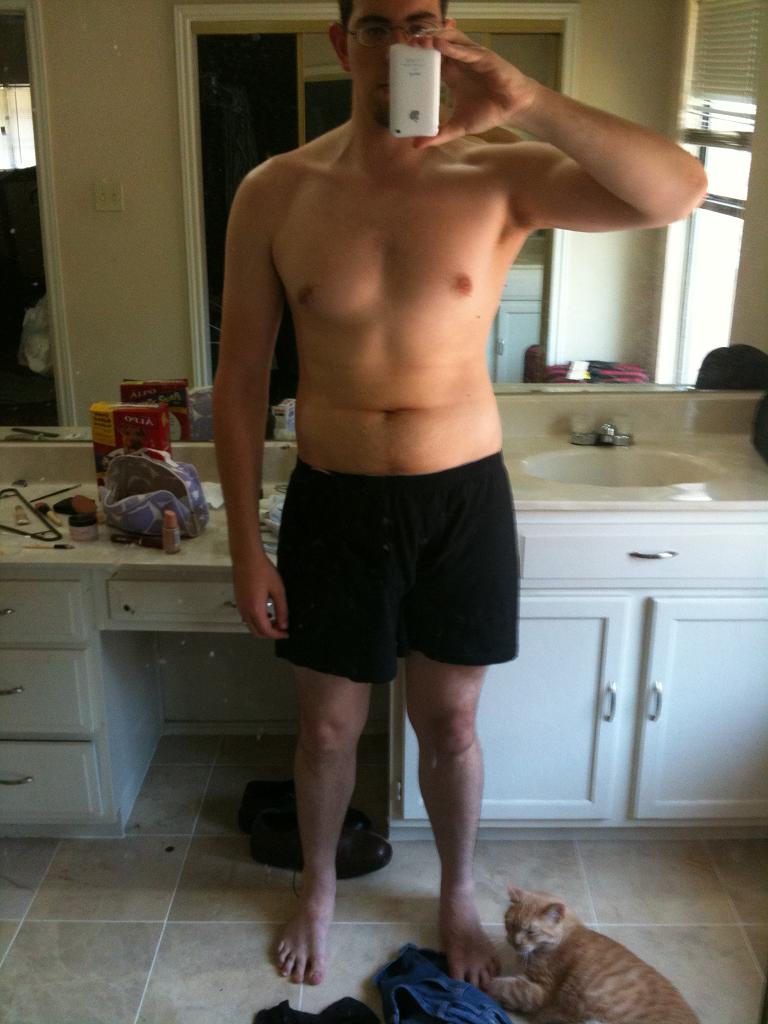
Overall, I feel a lot stronger. My muscles are more defined. And I no longer cringe when looking at myself in the mirror. I'll keep increasing the weight until I plateau either from the calorie deficit or from pain or injury. Hopefully the former.

Running
The inspiration for today's post. I ran a personal best 6.75 miles this morning. It was slow as hell, but it's still better than I've ever done. I did 5 miles barefoot, and the rest in my Luna sandals.

I outlined some of my running goals in an earlier post, but I basically wanted to be able to run a 10k in mid-April. So my training plan has been as follows. Twice during the week, I try to run about 3-4 miles, focusing on not wearing out the soles of my feet, and lately, focusing on increased pace. On Saturday, I focus on increasing my distance (regardless of pace). My initial plan was to increase by .25 miles each week, but I've actually been increasing somewhere around .5 miles.

It took a long time (I was at around 3 miles max distance at the beginning of the year), but I'm ecstatic with the results so far. I've already surpassed the distance needed for the 10k, which was a big mental barrier to break through. Now, I feel like with training (and hopefully about 20-30 additional lbs of weight loss), I might actually be able to do a half marathon at the end of this year or early next year.

One big thing that today's run taught me is that I should probably start carrying water with me. I'm thinking about getting a camelbak or some kind of belt, because I already feel like I carry too much crap in my hands (my sandals). My thought is to just strap it to my body somewhere and not worry about it until I'm thirsty. There might even be a pocket or something to store my sandals while I'm barefoot.

Putting it all Together
So, here's my schedule in condensed form:
  • Monday - Rest Day (And sometimes a cheat day on the diet. Nobody's perfect.)
  • Tuesday - Run 3-4 miles. Focus on pace and technique.
  • Wednesday - Lift. Plank workout and barbell exercises.
  • Thursday - Run 3-4 miles. Focus on pace and technique.
  • Friday - Lift. Plank workout and barbell exercises.
  • Saturday - Long run. Increase distance .25 - .5 miles. 
  • Sunday - Lift. Plank workout and barbell exercises. 
Eat 2200 calories a day. I try to eat as much protein as I can and the rest I split between carbs and fat, but I'm not fanatical about it.

Results so Far
It's been about 2.5 months since I started the lifting and diet, and I've lost almost 20 lbs. This was my weight loss goal for the 10k, and I've almost achieved it (a month early.) I'll keep chugging along and occasionally adjust stuff, but I'm pretty happy with the results so far. 

If it ain't broke, don't fix it. 

Talk to you next time.

Sunday, January 20, 2013

Blog<Running> - Electric Run

So, at the end of last year, I started looking for some fun 5k events for the new year. I wanted to give myself motivation to keep running through the cold, dark, wintry months, in preparation for the 10k that I'm doing in April.

One of those events was the Electric Run. I heard it described as equal parts running, Mardi Gras, and electronic dance party. After doing it last night, I'd say that's a pretty good description. (It was pretty family friendly though. There was alcohol at the finish line, but no bead/boob exchanges.) 

The Costume:
One of the cool parts of the event is that all the participants are encouraged to cover themselves with lights, and glowing things, and florescent clothing, and whatever else you can think of. The race started at 7PM and the darkness really makes all this stuff stand out. When I registered, I bought some glowing stuff that was being sold by the event organizers, and I figured I'd come up with some way to wear it all before the race. I got a package of "LED shoelaces", and a 3 yard light up wire... thing.

On race day, I opened my package of shoelaces and found 2 things.
  1. There was no obvious way to secure the "laces" to my bare feet. They were too short to tie around my feet, and the battery/switch part was a little too bulky (and I was afraid they would come undone and fly off my feet or something.)
  2. One of them didn't work.
Fortunately, I am somewhat experienced with electronics (I have a degree in an EE related field after all), so I disassembled the broken one and found the problem. One of the battery connectors had disconnected from the circuit board. Once I soldered the piece back on, I realized I could make some modifications that would allow me to wear it as some kind of electric finger... things. Long story short, I transformed it from this:


Works good for shoes I guess.


To this:
I've got the electric touch.
It turned out way better than I thought it would, and I think it looks pretty badass in the dark. When I got to the race, I taped the tubes to my fingers so that it looked like I had some kind of electric claws. If I had to do it again, I'd get some cheap black gloves and attach everything to them. After the run, and 2.5 hours of dancing, the tape stopped working so well.

The Race:
I got to the Cotton Bowl about an hour before the race kicked off, and I attached all my glowy things.  I made my way to the starting area and stopped for a pit stop at a row of port-a-potties. I think about half of the 6000 runners had the same idea because it took about 20 minutes to get to the front of the line.

After doing my business, I made my way to the starting line. A sea of thousands of glowing, flashing, dancing people. They split people into groups of about 1000, so I made my way into the middle of group 2. I had a few conversations about barefoot running as the people around me looked down.

At 7:05, it was group 2's turn to start. The crowd counted down from 10, and we were off! We all started off slowly. There were 1000 people of all different running abilities, and the course narrowed not to far after the starting line, so it was claustrophobic for about a third of a mile. Fortunately, no one stepped on my feet. :)

The run itself was great. The first corner had colorful umbrellas hanging from trees above and around the course. There were floating balls in the water along the running path. Everything was lit up, and there was some loud-ass EDM playing. After the first mile, we headed out into the parking lot and through some access roads around the state fair area.

Unfortunately, the second mile wasn't punctuated with as many flashing lights, glowing stuff, or loud music. The course also changed from smooth pavement to a rougher chip-seal-esque surface, where I really had to pay attention to my form. Occasionally there was some dirt and even some gravel to run through. Needless to say, mile 2 wasn't my favorite part of the night. It was split up by a water station halfway through the 3.1 mile course.

The last third had some more light/musical stuff. Spotlights projecting moving images, big screens playing video, more of those hanging umbrellas, big inflatable archways with lights that were synchronized to the music. I started to pass the people who went out too fast at the beginning. I heard a lot of "whoa, that dude's barefoot" around this point. Unfortunately, the ground never got any better. It switched from rough concrete to that mixture of pebbles and cement that you sometimes see in areas that are designed for shod pedestrians. I crossed the finish line to cheers from the volunteers and made my way to the stage.

The Dance Party
After getting some water, I put my sandals on and made my way to the stage where there was a DJ playing more EDM. I danced for a bit and then remembered to check my phone. 7:55. I can only guess that I finished the course in about 35 minutes, but I have no way of knowing (there was no timing system.) I walked over to the tents, bought a $6 miller light and walked around for a bit. I ended the night by dancing in front of the stage for the next 2 hours.

I talked to a lot of people about running barefoot. It's a pretty good conversation starter for someone who isn't great at starting them. :) I got a lot of positive reactions, a few concerns about glass, and a ton of "whoa, that's badass."

I also shot some crappy video on my phone. I apologize in advance for the shaky-cam footage. It's hard to keep your phone stable while holding it with taped fingers and running through a crowd of people.


Saturday, January 5, 2013

Blog<Fitness>

Jan 5, 2013

Hello, internet. I've decided to dredge this thing back up again. Long story short: I want to lose some weight that has crept back on over the past 2 years. A period, that had its good moments, but is mostly one that I want to forget.

So, my plan is to start keeping track of my fitness, my diet, and my weight loss (and whatever else I decide to track) in the hopes that the Internet Shame ™ will kick me into action again.

Part of it will be a meal and workout tracker and part of it will be goal tracking with (hopefully) weekly updates. Here are the 3 things I want to change the most, along with some goals for achieving the change:

Running
I want to be able to run further, and I want it to be barefoot. I actually had a pretty good year last year.I did my first ever 5K with my mom and cousin, followed by another 5K a few weeks later, and 6K (billed as 5K, but was at least a half mile more) trail run to end the year. All of them barefoot (and all of them with my mom). I have a 10K scheduled in April (also with Mom), and I want to be able to run the whole thing barefoot. That's basically my goal. Barefoot 10K in April. I'll create a new goal after that point.

Weight Loss
I want to be down to 200 lbs. I had been hovering around 230 all of last year until the holiday season hit. I just weighed myself and I'm at 238. It's depressing after looking back over this blog and seeing what I went through 2 years ago to get down under 200 lbs. Lots of stuff contributed to the lapse, and I might get into some of it in this blog, but long story short is that I want to be in better physical shape. Partly because it will help my running goal, and partly because I want to look good in the mirror. My short term goal is to be at or under 220 by my April 10K. My goal by the end of July is to be 200 lbs. I'll reevaluate after that.

Self-control
Less dependent on caffeine/sodas. I've been drinking about 2 cups of coffee a day and at least 1 soda, sometimes 2 or 3, for the past year. My goal for the duration of my weight loss is no soda (at all) and coffee only on the weekends. I like the way coffee tastes, but I don't want the dependency on the caffeine. This goal is mostly to prove that I have some self-control, and because I know that cutting out the extra calories will help me to reach my weight loss goal.


So, there it is. Starting 2013 with 3 attainable goals. My next post will outline my strategy for meeting the weight loss goal, as well as my initial food/workout entry. 

And then I'll probably cry in a corner because what the fuck have I been doing for 2 years?


-Kyle

Saturday, February 12, 2011

Blog<Meta> Retrospective

It's been a couple months since my last update. Sorry about that. It's a combination of end-of-the-year travel/holiday stuff and general laziness/procrastination. Okay, I'll cool it (a little) with the slashes. (But no promise on parentheses.)

I know it's well into the new year, but since I didn't do it in January, I'm going to use this post as an opportunity to reflect back on the previous year and to record my goals for the new year. So please bear with me as I do a little navel gazing.

Exercise/Weight Loss Goals
I had specific goals, so it's easy to judge my progress. Here was my one and only goal at the beginning of the year:
  • Go from 266 lbs to 206 lbs.
By the end of July, I had completed this goal. Around the same time, I found running as an enjoyable way to maintain the weight loss. As happy as I was to lose the 60 lbs, I realized I still wanted to get in better shape. So, I reevaluated my progress and set a few new goals for the end of the year:
  • Get down to 190 lbs.
  • Be able to run 5 miles.
By December I was hovering between 190 and 185. Success! I'm still hovering around this weight, but I've got a few different goals in mind for 2011 (which I'll get to in a couple paragraphs).

My goal for running was probably a little naive. I had just read Born to Run by Christopher McDougall. This book went a long way towards making me believe that I could actually run and enjoy it. But, after never running more than 1.5 miles in my entire life, I somehow decided I could run 5 miles by the end of the year. I didn't realize at the time that it would take so much effort and patience to learn the technique that allows a person to run long distances. And this is doubly important when running barefoot. Even with all the setbacks and generally slow progress, I was still able to get up to 4 miles on 2 separate runs by the end of the year. If you asked me a year ago if I'd be able to run 4 miles without shoes, I probably would have laughed in your face.

So the final tally for my exercise goals in 2010 was 2 successes, and 1 failure (but I made some good progress). Keeping this in mind, I've decided to divide 2011 into short term and long term goals. I've learned that short term goals are important because they are easier to visualize success, and upon completion, they provide motivation to continue striving for the long term ones. Long term goals are equally important because they provide you direction when you inevitably hit a roadblock or start to plateau. They are the reason for putting in all the hard work. As such, here are my goals for 2011:

Short term:
  • Run my first official barefoot 5k by the end of May.
  • Acquire access to an Olympic bar and weights, and learn proper technique on several compound lifts (squat, bench press, dead lift, overhead press, barbell row).
  • Create and follow a new diet geared primarily toward gaining muscle and burning (or at least not gaining) fat.
  • Create workout/diet journal to track progress for at least the first 3 months.
  • Gain at least 5 lbs of muscle in the first 3 months without increasing body fat %.
Long term:
  • Run an official 10k by the end of the year.
  • Squat: 5 reps at least 100% of my body weight.
  • Bench press: 5 reps at 75%
  • Dead lift: 5 reps at 100%
  • Drop from ~15% to 10% body fat by the end of the year.
  • Visible 6 pack abs (and finally lose this damn belly)
You'll notice that I'm planning on making weight training a big part of my exercise plan this year. A year of losing body fat and building a little muscle (mostly endurance) has left me with the desire to get stronger. You might remember that I hated my resistance training over the past year, and you might be wondering why the change in heart. Well, I've been researching again and I've discovered that I've basically been doing it wrong. BTW, those body weight % numbers are not considered strong by many standards, but I don't want to make the same mistake I made with running and just assume I'll get there easily. I'll be writing a post soon to talk about my new fitness goals and give more insight as to why I'm (finally) taking weight lifting more seriously.

Programming/Hobbies
This is one area where I haven't been very prolific. My intention when I started this blog was that most of it would be technical posts about programming and specifically creating games. I'd still like to continue talking about it, but the exercise/fitness stuff has been taking up a lot of my time and it reaches a broader audience of people. I didn't really have any goals last year, and I still don't really have any this year. You can expect the occasional game or prototype project update, so those of you who don't read this for the technical stuff can feel free to tune them out.

The Blog (meta-goals)
I had a few reasons for starting this blog last year. The main one is that writing things down helps to solidify them in my mind. And even if no one ever reads the blog but me, it's difficult to discount the pressure of Internet Accountability™. Of course the downside is that if I ever stop doing this for more than 4 months, the Internet Shame™ will keep me from ever dredging it back up. So part of this process naturally involves coming out of my cocoon and advertising myself a little. The more real readers, the harder it is to let myself quit.

There are 2 other main reasons. The first is that I want to become a better writer, and you only get better at something by practicing. The second is that (I think) I have something interesting things to say, and (if I can improve my writing) the information just might be useful to other people.

So, here were my goals for 2010:
  • Write something once a week.
  • Write something useful once a month.
  • Get some actual humans to read the blog.
  • Improve my writing ability.
Did I succeed? Well, my goals weren't very clearly defined. Heck, this is the first time that I've actually written these down, and I have to say they're pretty weak. I could come up with a few reasons why I succeeded, and I could come up with a few reasons why I still need to improve. If my weight loss goals have taught me anything, without specificity it's very difficult to analyze results.

The first 2 goals are better than the last two, but they don't mention a duration. Did I want to do this forever? For a year? A few months? If I wanted to keep up the volume of writing for more than 5 or 6 months, then I guess I've failed miserably. At the time I started the blog, I didn't really know.

The 3rd goal is even more vague, but I still think I did okay. I've got a small set of followers, comprised mostly family and friends. These are the people I'd actually want to give me feedback, so I'm fine with the small readership. Plus, there's still a pretty big mental stumbling block to overcome when I think that I actually have something important or useful to say. Plus, plus, strangers are scary. Anonymous strangers are basically the bogeyman. But still, it would be good to venture out of my shell a little more.

The last goal is almost useless. I don't know if I'm any better at this than I was in June. The idea was that practice would make it easier and improve the quality of my writing. After 6 months, it's definitely easier to type a lot of words in front of a computer screen. I have no idea if the quality has kept pace with the quantity.

Goals for 2011:
  • Write something useful/interesting once a month for the rest of the year.
  • Promote the useful/interesting posts on facebook.
  • Extra posts are a bonus, but I also want to start using the space as a way to give smaller/quicker status updates. As such, a set schedule or number doesn't really make sense.
I think these are better than the previous year's goals. As far as improving the quality of my writing, I'm not sure how to do this except to just solicit feedback occasionally. Honestly, I still think that writing more will naturally improve the quality, and I'm comfortable not having a specific goal.


Hopefully I'll be well on my way toward my 2011 goals by my next post. I think I might have found a good deal on craigslist for an Olympic barbell and weight set, so after a month of indirection, I'm starting to make some progress. :)

See you next time.

Monday, October 25, 2010

Blog<Running> A Few Barefoot Running Videos

After my last post, I realized it might be helpful to see what barefoot form looks like. Here's a few I watched when I was was in the beginning stages and a couple more that I found more recently. Note: none of these are of me. Maybe I'll get Lauren to record me running sometime, but for now this is what you get:


Intro to barefoot running:


A follow-up video by the same person:


Video of a woman running barefoot:


Long video of a barefoot runner. Kind of crappy sound quality, but his speed is pretty impressive.


And one more (notice the smile on her face at the 1:00 mark)


Thursday, October 14, 2010

Blog<Running> Beginner's Guide To Barefoot Running

I've had several people ask me about barefoot running over the past few weeks, so I figured I'd compile everything I've learned into a handy guide. Please keep in mind that I've only been doing this for a few months and that I shouldn't be considered an expert.

Why Do You Run Barefoot?
I get asked this question a lot. It's kind of hard to dive into my personal reasons for ditching shoes without sharing a bit of my running history first. Luckily, I've chronicled most of it in a few posts which are way too long for humans to read. But, maybe you're a robot, or some kind of super-intelligent literate cephalopod (we're equal opportunity here at Blog). In that case you can find my first 2 posts about why I started running here and here. And then maybe read a few posts where I started to realize that losing the shoes could be more fun: here and here.

Everyone probably has a different reason for trying barefoot running. For me, I just wanted to learn how to run. Period. I tried running in traditional running shoes and I ended up injured. I tried jumping feet first into the minimalist movement with a cool pair of toe shoes and I ended up injured again.

I tried barefoot running as a last-ditch effort before throwing in the towel for good, and all my previous pain has gone away. For me, barefoot running started as a way to avoid injury, and it turned into something that I find rewarding, freeing, and fun.

Most of the advice I'll be giving later in this post applies to minimal running as well. Not everyone is as dense as I am when it comes to learning proper "natural" running technique, so the minimal shoes might work out better for you than they did for me. But if you get frustrated or injured in your new "barefoot" shoes, remember that you can always take them off. While the soles of your shoes might be thin, the feedback of your bare skin just has no comparison. It made a world of difference for me.

How Pain Teaches Proper Technique
Pain is bad. A repeated painful motion can lead to long-term injuries. Pain from running is caused by 2 things: improper technique, and over-training. The underlying principal of barefoot running aims to solve both of these problems.

Traditional running shoes try as hard as they can to mask pain. That's why they put an inch of padding, rubber, gel, air, etc... between your heel and the pavement. The problem is that they can't tell you when you are running incorrectly. You could be pounding the pavement for miles before you start feeling any pain, and at that point you don't know what specific movement caused it. I used to get shin splint pain anywhere from 1-24 hours after I stopped running. How are you supposed to know which part of your form is incorrect, when you don't get feedback until it's too late?

By taking off the shoes, you remove all that extra stuff that is meant to hide the pain. Now, if you take more than 3 steps with bad technique, you will feel it immediately. If you overstride or push off with your toes, you will feel friction and get blisters, or maybe shin splints. If you don't land with your knees bent, or run with a straight posture you will bruise your feet from the impact. If you don't engage the entire surface area of your foot, you will get pain from over-use. Barefoot running teaches you to avoid this type of pain, and the benefit is that it naturally teaches you proper running technique.

So one of the most important things to remember when starting out is that pain is bad. Do not try to run through pain. Either your technique needs improvement (change your form until it doesn't hurt anymore), or you are doing too much too soon (call it a day).

Okay, enough with the boring stuff, let's move on to the actual advice...

Take It Slow!
If you are a typical Westerner, your feet have been locked up in shoes for most of your life. They have become dependent on all the support, padding, motion control etc... In short, your feet have become incredibly weak. I'm not talking about just your muscles, but also bones, ligaments, tendons, and skin. As you use them more they will get stronger, but for now remember that it's going to be a slow journey.

Your first barefoot run should be no longer than half a mile, but in all likelihood your feet will tell you to stop sooner. Your first time, you will probably end up with blisters, or bruises, or pain in the top of your feet. When you feel this kind of pain, stop and take at least a day off before trying again. You don't want to make the pain worse, as it could lead to injury. While you're resting, read the section about pain avoidance to see what you need to change. Starting off by walking barefoot is another good piece of advice that I wish I would have taken when I started.

Run Gently!
You need to avoid heavy and sudden impact. Without any protection between you and the ground, you can't afford to stomp or plod your way down the road. Fortunately, humans are practically engineered for this type of quick and light movement. Here are some tips to keep in mind as you go out on your first few runs.
  • Land on the front or middle part of your foot. Heel-striking is only possible if you are wearing big clunky shoes with a bunch of padding in the heel. If you run this way barefoot, you will bruise your feet. Instead, focus on landing on the entire surface of your foot. You should land slightly on the front of your foot and then immediately touch down with and heel. The more surface area you use, the more you will benefit from your arch's natural shock absorbency, and the less pressure you will put on any specific area.
  • Run on pavement/cement/asphalt. A smooth hard surface is the best place to learn proper technique. Roads and sidewalks are relatively flat and frictionless, and are hard enough that you must run softly to avoid pain. Save the grass and sand for special occasions. I recommend that you do 90% of your initial learning phase on a hard surface.
  • Take short quick strides. The less time you spend in the air between each stride, the less impact you will feel when you land. You can recover from many small impacts much easier than from a few large impacts. Imagine the difference between a car crash at 40 miles per hour and a few fender-benders at 15 miles per hour. Which one does more damage to your car? To your body?
  • Land with your feet directly under your hips. Over-striding causes a braking motion throughout your legs. When your foot lands in front of you, you nave to expend more energy to push yourself up and over it. This extra energy puts stress on your feet, shins, and calf muscles. It can transfer the impact force all the way through your ankles, knees, hips and into your spine.
  • Bend your knees. Your leg needs to act as a kind of spring. This means bent hips, bent ankles, and bent knees. As you land all of these joints should flex, storing energy to be released when you take to the air again. If you feel your feet plodding or slapping the ground, you probably need to bend your knees more.
  • Straight posture. You do not want to slouch or lean back. Your back, neck, and head should form a straight line. Any lean should be slightly forward and from your hips or ankles, not your back or head. Having a strong core allows you to use your body's center of mass to maintain your momentum.
  • Relax! You are way more likely to run lightly and with minimal impact if you are not tensed up. Remember that it's about staying injury free and having fun. Try smiling. It will freak out all those grimacing joggers to see you having fun while they're repeatedly pounding their feet into the ground.
One good way to think about running is as a controlled falling motion. Lean forward enough and you will start to fall. You will naturally move your foot to land under you before you face-plant. The momentum of this falling motion is what propels your body forward, not any kind of push from your feet or legs. Your legs are just there to make sure you stay somewhat in control and to efficiently store and release the impact of landing. You can easily control the speed of your run by changing the angle of your lean (it doesn't take a big change in your lean to cause a drastic change in speed.)

So What Role Do Your Feet Play?
Your feet are extremely sensitive instruments. They can feel a pebble or a slight change in the grade of your running surface and react instantly. They are like the active traction control system in a luxury sedan. If the ground slants in some weird direction, your foot will land in a way that keeps your leg directly over your center of gravity. If you land on a pebble, your foot will naturally relax around it, allowing you to keep running with only a small discomfort. In short, they allow your body to land in a way that provides maximum stability, support, and traction.

What Role Don't They Play?
Your feet should not contribute to your forward movement. Doing so is the fastest way to an over-use injury. Imagine for a second that you are pushing something heavy with your hands. Do you spend a lot of energy extending your fingers and wrist? If you are like me you only use your hands for placement or grip, and then you use your arms, chest, core, and body mass to move the heavy object. The reason is that your hands do not have the strength because that's not what they are designed for.

Your feet and ankles are built in roughly the same way. So, don't "push off" with them. Instead, allow them to provide your foundation and connection with the ground and then use your legs, core, and center of gravity to actually move your body forward.


I Did What You Said, But I Still Got Hurt
Over the past few months, I've encountered a lot of pain. It's one thing to read about proper form, and it's another to convert that knowledge into the proper movements. If you experience any pain, I've probably felt it before and can give a few pointers.
  • Blisters. Blisters are caused by 3 things. Heat, moisture, and friction. Hot roads might mean you need to cut your run a little short. Moisture from rain or sweat just means you need to be extra careful about how your feet contact the ground. Landing in front of your body can cause your feet to slide. Which brings us to friction. Friction is caused by a few things. Most likely is that you are landing or pushing off on only one part of the foot (usually the ball of the foot). The problem is that it puts most of your body weight on a disproportionately small surface area. Your skin just isn't mean to handle that type of pressure for too long. The solution is to try to shorten your stride so that your foot lands directly under you. This also increases your stride-rate so that your foot physically spends less time on the ground. Try to land on as much of your foot as possible, and then try to lift it straight up without pushing off with your toes. Also, avoid any twisting motion. Once your foot is on the ground, it should stay motionless until it leaves again.
  • Shin Splints. Shin splints are caused by 2 things: over-striding and over-use. The first one can be solved by shortening and speeding up your stride (seeing a common theme?), and the second just means you need to take it a little slower. My shin splints went away naturally when I corrected my stride to avoid blisters.
  • Top of Foot Pain. Top of the foot pain is caused by "pushing off" with the ball of your foot. Your foot muscles, bones, tendons, and ligaments are not meant to endure that much stress. You can easily correct this problem by focusing on lifting your foot instead of pushing off with it. Your entire foot should lift off the ground at the same time. It helps to try pulling your toes and ball of the foot up before the heel. You can also try running on gravel or a rough surface. You will immediately know if you are pushing off because it will hurt the ball of your foot.
  • Bruised Soles. Bruising is caused by not running softly. You need to make sure you bend your knees (probably more than you think). Land with relaxed feet and make sure that you land with the entire foot so that you are spreading the impact across more surface area. Again, you can try standing, walking, and eventually running on gravel as a way to make sure you are landing and lifting off with your entire foot. Put more pressure on any one area and it will be very painful.
  • Rocks, glass, dog poop, needles, etc... If you somehow manage to step on glass or dog poop without seeing it, then I recommend that you open your eyes. Seriously. It's easy to avoid 99% of everything on the road just by looking at it and going around. You will find it surprising how little glass and debris is actually on the road. I've never seen a needle in the street. You will on occasion step on a well-disguised rock or twig, and it will hurt for about 3 steps, but if you run gently your foot will naturally roll over it and avoid most of the pain. After a few steps you will have forgotten it was ever there. And if not, it just means you need to run more gently. :)

Well, that was long (big surprise if you have read this blog before), but hopefully it's a good primer on getting started. Just remember to keep it light, and keep it fun. You won't learn perfect technique in a day or a week (or even a month or more), but if you keep at it you will get better. Eventually you'll make it to a mile and then two, and before long you'll be doing a barefoot 5k or further. Maybe you'll eventually be able to do a half or full marathon, or even longer. Happy running!


Other Resources
  • http://therunningbarefoot.com/ This is basically the original site on running barefoot. A lot of the information in this post is the direct result of reading and trying the tips and advice from this website.
  • http://www.runnersworld.com/community/forums/runner-communities/barefoot-running/ A forum at Runner's World, specifically for barefoot/minimal runners. The people there are generally knowledgeable and there's about a 40/60 split between barefoot and minimal running.
  • http://www.barefootrunners.org/build2/ I haven't spent a lot of time here, but The Barefoot Runner's Society is a site with a lot of information about races/events/meetups. It also has some pretty good forums.
  • There are lots of other resources out there. Just do a search for "barefoot running" and you'll see that it's not such a tiny/crazy movement.

Sunday, September 12, 2010

Blog<Running> Fun in the Rain

This past Tuesday was the kind of rainy day that makes you want to just stay inside and do nothing. For most of the day, I was your normal middle-class American. Running between building and car, trying to stay dry. Side-stepping puddles to avoid an hour or two of soggy shoes while you sit behind a desk. It's kind of funny how much less you care about getting wet when you know you can take the shoes off.

One benefit of running barefoot is that rain is less of a deterrent than heat. There is a little discomfort while transitioning from dry to damp, but since I'm a pretty heavy sweater* I'm used to working out in wet clothes. Still, I didn't see any of the usual evening runners/joggers. Maybe they didn't want to mess up their shoes? For the unshod, a little water is no obstacle.

So, I was happily running through the rain, coming up on the end of my first half-mile loop, when I saw a guy gardening out in his front yard. Ordinarily I'd think this guy was crazy for doing yard work in the rain, but I suppose if you put our 2 activities in a line-up you'd get just as many people calling me crazy. On the other hand, I looked like I was having fun, and this dude looked like he may have been escaping something worse.

As I got closer to him, he looked up from his spot on the grass and stared for about 10 seconds before finally yelling out "doesn't that hurt!?"

I was at the end of my first half-mile, maybe 20 feet from the spot where I usually stop to verify the quality of my form by examining my feet (sole-searching as I like to call it**). Since I was going to stop anyway, I decided to have a quick conversation with the guy. I explained how it helps your form. I explained the concept of removing the cushioning of shoes to force you to run smoothly. I brought up the fact that thick-heeled, modern running shoes have only been around since the 60's.

The guy didn't seem convinced, as there was still a hint of "you must just have a high pain threshold" in all of his responses. After about a minute of neither of us convincing the other, he told me to "keep it up." I said "thanks," and for my closing argument I yelled back over my sholder "it's more fun than running in shoes." I then proceeded to stomp my way through a 3-inch deep puddle. I may have played it up a little to make sure he knew that, at that moment, I didn't have a care in the world.

I passed the guy 2 more times for a total of 1.5 miles***. A ray of sunshine in an otherwise dreary day.


* By pretty heavy sweater, I mean that I perspire a lot. Despite what you might have heard, I am not a fashionable, winter-time, article of clothing.
** I don't actually call it that. I'm so sorry.
*** A new personal best for barefoot running.

Tuesday, September 7, 2010

Blog<Losing Weight> 8 Months Later

Changing It Up

In the last post about my weight loss, I talked a little about my new goals. I had just just lost 60 lbs over the previous 7 and a half months, and I was still in the mindset of measuring success by the number on the scale.

Fast forward a few weeks, and I've finally started to let myself stray from the strict dieting, long cardio, and boring resistance training that got me to this point. That's not to say that I'm not still watching what I eat and exercising, but I'm a little more relaxed about it. I'm starting to ease myself into more of a maintenance mode (with a little bit of weight loss along the way).

For most of the year, I was doing 4 days of elliptical per week (55-70 minutes 3 times and 80-120 minutes on Saturday). And on 2 days, I was lifting weights for about 45-60 minutes. I have to say that I'm happy with the results, but after 7 and a half months you start getting sick of it.

So I started to think about how to minimize my time in the gym.

The first change I made was to replace some of the elliptical days with running. I started off replacing 2 days, but that has recently grown to 3. I still do my 2 weight-lifting days, but I've been trying to switch up the exercises I do from workout to workout. And finally, I replaced the last elliptical workout with a HIIT workout and added another HIIT workout on what was previously my rest day.

Normally I wouldn't recommend 7 workouts in 7 days because it's usually a good idea to have at least one day a week to let your body recover. My take is that life normally intrudes and forces a day (or more) off anyway, so if I can't work out on a given day, so be it. Because of this, I've only actually completed the 7 workouts in 7 days once in the past month.

The new schedule means less time in the gym and no more mindless cardio. The HIIT workouts hurt pretty bad but you can't say they're boring, and they only take 40 minutes each (including warm-up and cool-down). The three running days probably add up to 45-60 minutes total since I'm still a beginner. And, as a bonus, running is actually fun. My weight-lifting days are still a drain on my motivation, and they still take 45-60 minutes each, but they're important with all the potentially-muscle-burning cardio that I'm doing.

As of this morning, I'm down to 198 lbs, which is what I weighed near the end of my freshman year in college. 8 lbs in 6 weeks is significantly less than the 2 lbs per week I was losing before, but the important thing is that I've mostly had fun doing it.

8 lbs also happens to be the half-way point for my end-of-year goal to slim down to 190. I normally don't like counting my chickens before they hatch, but I'm pretty sure this one's in the bag.

Sunday, July 25, 2010

Blog<Running> 2 Months Later

I've been running for about 2 months now, so I figured I'd share another update on the little successes (and failures) I've had along the way.

Distance

The distance is coming along slowly. I started with a .5 mile runs, and after about 3 or 4 weeks increased that to 1 mile. Since then, I've generally been trying to stick to the 10% rule (increase distance by no more than 10% every week.) Yesterday, I ran 1.3 miles, so I'm on track to break 2 miles in about a month and a half.

I have to say that the progress at this point is almost unbearably slow, but it's not just the arbitrariness (arbitrarity?) of the 10% rule that I feel is holding me back. Once I reach the 1/2 to 3/4 mile mark I kind of hit a wall where I'm suddenly not having much fun anymore. Part of it is the Dallas summer heat, and part of it is the fact that I'm not a morning person (but I have to get up early to beat the heat). And another part is that I'm just not physically conditioned for running yet. I don't feel in sync when I get to this point, like I can feel all 205 lbs of myself at every step, like some self-conscious, lumbering giant. A giraffe with lead boots. It's a big difference from the stealthy ninja feeling I have at the beginning, and I really have to concentrate to keep it smooth and relaxed.

And now I'm talking about the things I feel for the entire duration of my runs, but I'd rather not be self-conscious the entire time, especially if I ever get the point where I can run for more than 20 minutes. If it's anything like swimming, there's a point where your brain turns off while your body goes through the motions. It's kind of relaxing, almost meditative. If it exists for running, I hope I get there soon.

Barefoot Running

A couple of weeks ago, I decided to take off the VFF's and go for a real barefoot run. I mentioned it a couple of posts ago, as a way to help improve your form. Well, I tried my hand (foot?) at it a one more time since then, and it was a total disaster.

First, I made the mistake of trying it after work one day. The temperature outside was about 95 degrees, and the temperature of the sidewalk was probably 10-15 degrees hotter than that. Second, I made the mistake of only running on the sidewalk (which is a way rougher surface than the road, which I had stuck to on my previous barefoot run). And my last mistake was that I naively thought I could run the same distance as before without any problems, despite the difference in my environment.

I ran about .3 miles when I started getting "hot spots" on the balls of my feet. I pushed through it a little bit, which in retrospect should have been my sign to stop. I ran a little further when I noticed the ball of my left foot felt like it had some kind of air pocket stuck to it. I could feel it squishing a little when I landed on it. Actually, forget that. Sure, there was certainly a squishing feeling, but it was accompanied by its good friend, pain, who managed to deliver a much more intense sensation. So I stopped after only making it .4 miles, and hobbled the short distance back to my house.

The heat and friction of the sidewalk had created a blister from my 2nd to 4th metatarsal on the ball of my left foot. It was like the skin on the sole of my foot had separated from the flesh underneath, and the resulting pocket had been filled with some clear fluid. I made the mistake of popping it and then putting hydrogen peroxide on it. The peroxide actually went inside the blister where it created a layer of tiny popping bubbles, which slowly expanded to fill the void. I could have swore my foot was on fire if not for the fact that there was no accompanying seared flesh smell.

It took 3 days to heal to the point where I could walk normally again. Needless to say, I probably won't be going for any more barefoot runs after work.

Maybe in November.

Improved Form

It's crazy to look back to when I first started out with the forefoot style of running and compare my form then and now. Here's a small list of some of the things I've learned:
  • It's okay to let your heel touch the ground. Actually, the sooner it touches the ground the better, as it means you are spreading the impact across the entire surface area of your foot, and you won't put as much strain on your calf and achilles tendon. I would venture a guess that it's probably better to land on the entire foot simultaneously, but it's really hard to do without hitting heel first.
  • Don't spring off the ground with your toes. This causes a lot of stress (pain) on the top of the foot and in the ankle, and introduces an unwanted up and down motion. Instead, lift the toe and heel off the ground simultaneously. This is actually a pretty difficult motion to learn, and the slight pain in the top of my foot means I'm not good enough at it yet.
  • Focus on moving forward, not up and down. Vertical movement wastes energy. Not only that, but it adds extra stress to your foot landing. Normally, when something starts hurting (like my shins) it can be immediately remedied by minimizing my up and down motion. Bent knees help a lot here. Bend them to the point that it feels almost like you're sitting down.
  • Fast cadence with shorter strides is better. 180 steps per minute (or quicker) is recommended. With my long legs, I find this really difficult, but it does seem to keep my form smoother.
  • Don't try to control the natural inward roll of your foot. As someone with flat feet, I tend to over-pronate. For a while, I tried tensing up my foot and ankle muscles to prevent my foot from rolling inward. This just caused horrible ankle and foot pain, and gave me a bruise on the sole where I was landing. By letting my foot land naturally, I quickly ended the pain.
  • Along the lines of the previous point, don't fight through pain. Pain is there to tell you that you are doing something wrong. Continuing to repeat the painful motion will only make it worse and lead to injury. If it feels like something in your joints or bones, or like your muscle is about to give out, then either something is off in your form (you should change it up so the pain goes away), or you are doing more than your body is ready for (you should stop and build up gradually).
  • Running works your abs like crazy. A few weeks ago, I noticed that I had a mild stomach ache after a run. I thought maybe it was just a cramp, or maybe gas. When it persisted after each run, I thought that maybe my body just wasn't made for running and that my stomach was taking some kind of revenge for shrinking it down to a normal size. Well, it turns out that running with good posture and minimal upper body movement means your core has to do some stabilization, and as a result it gets a great workout. On my last run, I pressed a few fingers to my stomach and felt an almost constant low intensity flex, with a stronger flex on each step. Whatever thoughts I had of moving my ab days to coincide with my running days have now been thrown out the window.
What's next?

As I mentioned in the last post, I want to be able to run 5 miles by the end of the year. If I can keep increasing the distance by 10% every week, I'll be doing 5 mile runs in 16 weeks. However, if my recent running experience has taught me anything, progress will probably be a little slower. In any case there are 23 more weeks left this year, which seems like a reasonable time frame. Feeling motivated!

Saturday, July 17, 2010

Blog<Losing Weight> Goal Achieved!

Success!

Last week I talked about how close I was to achieving my weight loss goal. I normally do my official weigh-ins on Sunday morning, but I was so excited at the prospect of finally getting there, that I couldn't wait. My weight this morning was 205.6 lbs. That's a loss of a little over 60 lbs since January! Here are a few fun facts.
  • Total weight lost: 60 lbs
  • Time taken: 6 and a half months
  • Avg. weight lost per week: 2.14 lbs
  • Total calories burned: 210,000
  • Avg. calories burned per week: 7500
  • Change in BMI: 32.38 - 25.07 = 7.31
  • Change in BMR: 2505 - 2131 = 374 cal
Before and After

My reason for trying to lose weight was because I looked in the mirror and didn't like what I saw. In January, after over-eating at Thanksgiving, Christmas, the New Year, all of that Winter-time hibernation-mode eating, piled on top of a few years of not getting enough exercise and eating fast food all the time... after all that, I looked in the mirror and realized I needed to make a change.

Half a year ago, I used to start breathing heavily while walking up stairs. I used to get a rash from my thighs rubbing together. My feet used to get sore after standing for half an hour. I used to get acid reflux at night. The Texas heat used to bother me more. I used to struggle to lift heavy objects. I couldn't run a mile if my life depended on it. I used to depend on caffeine to get me through the day. The only positive thing about being so overweight and out of shape was that my clothes fit better than they do now.

That's not to say that the past 6 months have been peachy. I've suffered nearly every non-serious injury/malady you can think of while exercising and dieting my way into shape: shin splints, dehydration, friction blisters, runner's trots, pulled muscles, exercise-induced nausea, hyper-extended knees, crazy foot/ankle pain, hunger, caffeine-withdrawal headaches, and more sore joints than you can shake a stick at. But despite the setbacks and minor (sometimes major) discomfort, it was all worth it to get to where I am today.

Now I look in the mirror, and I don't cringe. I'm not completely happy with how I look (yet), but I love how I feel.

The Pictures

Before I started my weight loss plan, I decided to take some pictures so that I could compare my old flabby body with my new toned and firm one. It is with great embarrassment that I am now posting these pictures. Hopefully you don't need me to tell you that "old and flabby" is on the left, and "toned and firm" on the right, but I just did... so there.

Body - Front

Body - Side

Face - Front

Face - Side


What's Next?

As I mentioned earlier, I feel great, but I'm still not completely satisfied with how I look. I still have a roll of fat around my belly that I'd like to get rid of, and I'll be damned if I can't melt it off by the end of the year.

For now, the diet and exercise have become such an integral part of my life that I probably won't change much from what I've been doing. I plan on focusing more on running and generally trying to have fun during my workouts so that I can eventually transition into some kind of weight-maintenance mode.

So, my new goals for second half of the year are not quite as extreme as the first half:
  • Get down to 190 lbs (16 lbs over the next 24 weeks should be easy)
  • Be able to run 5 miles

That's it for now. See you next time!

Saturday, July 10, 2010

Blog<Random> Writing, Weight Loss, and Running Barefoot

Just some stuff I've been thinking about.

Writing

I'm a little embarrassed by the story I posted yesterday. There's a kind of self-conscious debilitation that usually prevents me from writing as soon as the idea pops into my head. Like I'm a hack, trying to keep my secret from everyone. It's part of the reason for this post, to push the story down a little, off the front page. At least now people will have to click a link or scroll down to find it.

But, I liked the idea, and if I didn't write it down, it would be rotting in my brain. And if I didn't post it here, it would be rotting on my hard drive. Now it can rot on the internet.

Your welcome, the internet.

Personal embarrassment aside, please fire away with your critiques. I'd like to get better, so don't hold back. After writing this one, I've got a few ideas along the same lines (immortality, fear of dying, existence, etc...), and I'd like to not feel quite as embarrassed the next time.

Weight Loss

I'm a week or two away from my goal. If it weren't for the 4th of July weekend (gained about 3 lbs!), I'd probably be there already. But I knew I'd have to work off all the food before I ate it, so it wasn't really a surprise. Once you get comfortable with your diet and exercise plan, the only thing that really surprises you is when you lose more than you thought you would. There's always an explanation for weight gain.

On the motivation front, the past couple of weeks have been difficult to keep a schedule. The week before the 4th of July, I only got 3 workouts in. Then, we got back from the vacation on Tuesday, so I only had 3 days this past week. On Thursday, I almost skipped my resistance training (I hate weight lifting.) I was halfway to my car before I made myself turn around and go back to the gym.

Hopefully this week I'll get a solid 5 days in (plus a run on Saturday), because I'll be going on vacation again the following week. It would be nice to put this goal to bed by then.

Running Barefoot

Last week, I went for a run in my Vibrams. I could feel some slight shin splints pain almost immediately. I ran for about 1/4 of a mile and decided to start changing up my form to see if it would make a difference.

I bent my knees more (kind of like sitting in a high chair, with your feet hanging down to touch the ground.) I also focused on moving forward instead of springing up and down. I noticed an improvement right away. The shin pain didn't go away, but I could tell that I wasn't making it any worse. I kept up this new form for about another half mile before it started slipping. The remaining 1/4 mile back to the house was a battle of concentration.

The experience of changing my form and feeling relief was pretty exciting. I opened my favorite web browser and found a pretty awesome site about barefoot running. The founder of that site, a caveman-looking dude called Barefoot Ken Bob, has run over 75(!) marathons completely barefoot. He recommends not wearing minimal shoes (like the Vibrams) when you are just starting out because, even though they're thin, the sole keeps your foot from feeling the ground and still allows you to pound a little.

He was right! This morning, I decided to do half of my mile run completely barefoot. I could tell immediately that my form in the Vibrams wasn't as smooth or low-impact as I thought. I know that I've gushed about the feeling you get in the Vibrams before, but it really doesn't compare to actually going barefoot.

I'll probably write more about it next week, but if you are thinking about taking up running in minimal footwear, I highly recommend trying it completely barefoot. Just remember that the goal is not to push through any pain you feel, it's to avoid pain. And you can only avoid pain by improving your form and by slowly building up your endurance. So, don't go further than your feet are ready for. 1/2 a mile was my limit today.

Sunday, June 27, 2010

Blog<Running> Learning To Walk

In my previous 2 posts about running I talked about taking it slow, listening to my body, maintaining proper form, and not injuring myself. That progress would be slow, but eventually I would be able to run longer distances, pain free. It turns out that progress is even slower than I first thought.

In that last blog post, I outlined my plans for strengthening my flat feet. I would cut back on the running attempts and wear my Vibrams every day at the gym. After my feet got stronger, hopefully my shin splints would be under control, and I would be able to start running for longer and more frequently.

Stumbling Block

Over the week following that post, I started feeling pain in my feet. I'm not talking pain from impact, or general soreness from using the muscles in my feet. This felt more serious. It was like the shin splints moved from my shins down into my ankles and feet. But it was worse than shin splints because instead of only feeling pain when I walked, I also felt it while just standing or sitting too long in the same position. There were two spots on each foot (on the inside and outside, just below the ankle) where it hurt to touch, almost like a bruise.

Looking back on my plans, I'm reminded of the Greek proverb:
Learn to walk before you run.
I think I was asking too much of my feet, too soon. They've been locked up in rigid shoes for my whole life, and I was expecting them to magically get stronger in a few weeks. I didn't want to aggravate them any more (and it hurt to walk around anyway), so I took a week off from working out. Last week, when I started back, I wore my cross-trainers instead of my Vibrams on the elliptical machine. Until this morning, I hadn't run at all in 3 weeks.

Getting Back Up

For the past couple of days, my foot pain has gone away completely (the human body is kind of incredible like that.) So, this morning I attempted a run. I was able to go about 3/4 of a mile without pain, and then I decided to stop before hurting anything. After my run, on my short cool-down walk, I started feeling some pain again in my ankles, so I'm glad I stopped when I did.

If you don't learn from your mistakes, you're doomed to repeat them, so I'm changing gears for what seems like the 5th time. I need to slow down again, and this time test the waters a little before jumping in with both feet.

My plan for this week is to continue wearing my cross-trainers on the elliptical machine, but wear my Vibrams on my 2 weight days. I'm still going barefoot at home and wearing sandals when I have to go out in public. Then, if my feet feel okay next weekend, I'll go for another run. I'll run until I start feeling pain, or until I reach the .8 mile mark.

I'll keep doing this (gradually increasing my run distance if I can) until I can go a full week without foot pain. Then, I'll start replacing my cross-trainers with my Vibrams on some of my elliptical days, and replace at least 1 elliptical day with a run instead. By the end of August I'll hopefully be able to throw away the cross-trainers for good.

I'm sure there are flaws in this new plan as well, but it's good to have a goal to work towards. I'll be keeping this blog up to date as I make progress.


Some Miscellaneous Observations

There are a few things I noticed over the past 3 weeks that didn't really fit into the text above, but I feel like they might be useful to put in writing.

1) The elliptical machine. The strange thing about the elliptical machine is that it's a rigid, defined motion. Your foot moves maybe an inch inside its stirrup (that seems like an apt description of the thing that keeps your feet attached to the machine) over the course of several cycles. It's almost like wearing shoes outside of your shoes. So when I wear the Vibrams instead of my cross-trainers, it doesn't really feel any different. At the same time, my almost-naked foot doesn't really feel "right" in the stirrup. I have more range of motion in my foot because of the Vibrams, but I'm still performing the same movements over and over for 50-60 minutes.

I think it was this repetitive motion that caused me a lot of the pain over the past 3 weeks. Without any variation in terrain, my foot's ligaments and joints were just grinding back and forth, back and forth, over-training very specific muscles, ligaments, and tendons in my feet. Since the pain went away literally days after I switched back to my cross-trainers, I'm pretty confident that this was the case.

The conundrum is that most of my strength training workouts involve sitting or lying down. The only time I'm on my feet is during my elliptical workouts. To improve my foot strength, I need to be doing more, but not so much that I over train and injure myself. The best plan would probably involve stopping partway through my elliptical workout and switching shoes, but who wants to change shoes in the middle of the gym? Sometimes I think to myself that if I get off the machine now, it's not very likely that I'll get back on. So hopefully my plan of mixing in one day of elliptical with the Vibrams will allow me to get there gradually.

#2 Conflicting Goals. I have two fitness-related goals at the moment. For the past 6 months, I've been trying to lose a specific amount of weight. And for the past month and a half, I've been trying to become a runner. The problem is that in order to lose weight at a quick pace, I need to burn a lot of calories during my workouts; and since I'm a newbie runner, I can't use my runs yet to replace a cardio workour. Furthermore, the setbacks I've experienced so far while running have crossed over to the weight-loss side. When I took a week off to let my feet heal up, I had to stop my weight-loss training as well. Fortunately, I'm only a few weeks away from meeting my weight-loss goal (5-6 more lbs) and I can start focusing more on running.

#3 Perseverance. In the past, I would have given up on the running a long time ago. As soon as I felt the shin splints the first time, or the foot pain from the past few weeks, I would have probably thrown in the towel. For whatever reason, I seem to have turned a page mentally. I've been able to stick with the weight loss, I've been able to stick with the running (even though there have been few victories), and after a month of I've also been able to stick to updating this blog at least once a week. Hopefully the feeling decides to stick around for a while.

Saturday, June 5, 2010

Blog<Running> Part 2

If you managed to get through part 1, you were probably wondering what my history with swimming, my recent motivation to lose weight, and my newfound interest in running have to do with each other. Well, here it is:

Why Running?

The elliptical machine is a great tool for working out. It's low impact, it has a variable resistance, it's climate controlled, it's about 15 feet from a large tank of cold water, and it's green (the one I use is powered by the cycling motion).

It's also incredibly boring. If it weren't for several podcast subscriptions, I wouldn't be able to motivate myself to workout every day for 30 minutes, let alone 60-90 minutes. It's stationary, it's the same motion minute after minute, day after day, month after month, and honestly, I started getting tired of measuring my progress with calorie counts, or watts, or cycles per minute, or even heart rate.

I wanted to do something where I wasn't just running in place. Where I could go for a while and let my body tell me how hard I was working and shut all of that other stuff out. I thought about swimming, but it's just too inconvenient. By the time you drive to the pool and get changed you've already wasted 30 minutes. Then, you have to find an open lane (or share with someone willing). Once you're done you have to take a shower, change and drive home. That's another 30 minutes gone. Swimming is something that I enjoy, but if I've learned anything from my recent weight loss it's that you have to put yourself in the best possible situation to succeed. For now, swimming just doesn't fit the bill.

So I still needed to find my convenient, low impact, cardiovascular exercise. Cycling is too much of an investment (and between you and me, traveling great distances is a recipe for getting lost). Rowing? What is rowing? How does a person even start rowing? Basketball, tennis, soccer? They all require coordination with other people, and wouldn't necessarily let me go at my own pace. And they are also not very "low impact". So, what's left?

Well, for a couple of months now, I've been reading various articles about the evolution of the human foot, and about how modern shoes make our feet weak and more prone to injury. Then I started seeing people post about their Vibram FiveFingers on facebook and twitter.

My interest was officially piqued, but I have always had problems with running. Also, how the hell does using less cushioning translate to a lower impact?

Running Form

This is the first piece of advice I normally receive when I ask how to be a better runner: get proper running shoes, with a big padded heel and a stiff high arch for your flat feet. In the past, I would try to follow this advice. I would get the shoes and start running, and for the first 3 or 4 runs I would be fine. Then I would start developing shin splints, or I would roll my ankle (even with the rigid support of the shoes). Then, after a couple more painful runs, I would stop altogether. After a few rounds of trying and failing, I eventually gave up for good.

But recently, I started seeing all of these articles about people running pain free, either barefoot or in their Vibrams. Even people like me who have flat feet and suffer from chronic shin splints and weak ankles.

I went on a research bender. I found a bunch of websites and blogs with information about minimal or barefoot running. I read the research on impact of heel strikes versus forefoot/midfoot strikes. I discovered how running can be "low impact".

The gist of it is that your foot has more nerve endings in it than any other place in your body (well, technically there is a place where they are more concentrated, but it's probably not as big as your feet). These nerves are there to tell your brain what you are stepping on, so that your brain can tell your feet how to keep moving safely. Your primary contact with the outside world is through your feet, so having that connection is important. It's an extremely sensitive feedback loop that has been honed over hundreds of thousands of years of evolution.

When you wrap your feet in a big padded shoe, you are cutting off this feedback loop. The problem is that your feet still want to "feel" what they are running on. Add more padding, and you have a tendency to pound your foot down on the ground. Your brain is trying to push your foot through all that rubber, or gel, or air cushioning so that it can figure out the safest/most efficient way to move. Well, now, you are literally stomping the ground with every step, so it's no wonder that running is so high impact.

Now take off your shoes and run. Pounding the ground for even 100 steps will be incredibly painful. You will naturally become more careful about how you land because you want to minimize the impact that you feel. You will also begin to realize that landing on the front of your foot is easier than the heel. This is because all of the force of the impact will be handled by the soft tissue in your feet and legs (tendons and muscles), instead of the hard tissue (bone and cartilage). Your soft tissue has this miraculous ability to stretch and store energy. So instead of just absorbing the impact in your joints, you're compressing and storing the energy in the natural springs in your feet and legs. Energy that will be released when you follow through with your stride.

That's the theory anyway. There's actually not a lot of scientific research in this area. Just anecdotal evidence, and that common sense light bulb in your head blinking "no shit".

Running: First Attempt

So, using this knowledge, I finally decided to go out for a run in my old New Balance cross trainers (the closest thing I have to a shoe that I could reasonably exercise in), focusing on landing with a forefoot strike instead of a heel strike. I ran/walked for about 2 miles until my calves were on fire and I couldn't go any further. I didn't feel any shin pain though, so a couple days later I went for another run. This time, I was able to go a little further, but I started to feel the familiar pain of shin splints coming on.

Not wanting to give up, I did more research. I found that shin splints have many causes, one of them being flat feet. When your foot has a weak arch (or low arch) it tends to roll inward more than usual when you land on it. This pulls and stretches one of the muscles that attaches to the inside part of your shin bone. This constant stretching causes the muscle to start tearing away from the bone, which is what causes the pain in some types of shin splints. It also just happens to be the same part of my shin that hurts after running.

Okay, so all I need to do is fix my flat feet.

Running: Second Attempt

More research. Again, there is no scientific evidence to prove (or disprove) what I'm about to say, but the ideas resonate with that same "no shit" feeling. Shoes and orthotics with high, rigid arches (made for people with flat feet) cause your feet to weaken. If you rely on some external structure to fix your arch, then your foot's muscles start to atrophy. Eventually, you will completely rely on the arch support. When you take off your shoes and stand upright, your feet roll inward because you are not used to standing without the external support. The shoes actually make your flat feet worse.

So, the "solution" is to train your foot to support itself again. Time to lose the rigid shoes and go natural.

Well, almost. Since I wasn't ready to take the plunge into barefoot running, I went out and bought a pair of Vibram Sprints. They feel like you aren't wearing anything. You have full range of motion of the entire foot (including toes), and there is absolutely no arch support. The only thing between your foot and the ground is about 5 mm of flexible rubber. You feel every twig, pebble, and crack in the sidewalk. Interestingly, you start avoiding the dangerous things you would normally step on while wearing shoes.

So last Saturday, I went for a jog in the Vibrams. I'd been told to not go more than half a mile for the first run, and that was good advice. It was over in about 5 minutes. Just long enough to start falling in love with the "shoes", and not so long that I was in pain. The freedom I felt in the Vibrams was amazing. It reminded me of what it felt like to run around barefoot in the grass as a kid. In that brief half mile, running was fun. On top of all that, I didn't feel any more pain in my shins.

After my first experience with the Vibrams, I bought and read Born to Run by Christopher McDougall. Upon reading it, if you are like me, you will immediately want to go out and run a 100 mile race through the mountains. So, I impatiently went out and ran 2 more half miles in the next 3 days. That was a mistake. I ended up aggravating my shin splints from my first (shod) running attempt from the previous week, and I started feeling pain in my knees. The thought of miraculously becoming a runner made me go out way too fast and way too hard.

I got a much-needed reality check.

Today

After my ill-fated attempt to run for the past 2 weeks, I decided to take it slower. I gave myself 3 and a half days off from running and threw some tried and true recovery techniques at my shin splint problem: ice, stretching, massage, shin muscle exercises, and Motrin. While waiting for my knees and shins to recover, I still went to the gym to lift weights and run on the elliptical machine. I didn't want to have to sit out for too long and lose any momentum (or endurance), so the elliptical machine's ultra-low impact motion is nothing short of a godsend.

In addition to the cure for shin splints, I started working on some preventative measures. Over the past week, I focused on improving my arch strength. At work, I loosened my shoes a little, and tried not to let their arch supports do the heavy lifting. At the gym I wore the Vibrams, and when I got home, I walked around the house barefoot.

It sounds kind of ridiculous, but after focusing on letting my own feet support my arches for a week, they already feel stronger. Maybe that's just me being optimistic, but there are muscles in my feet that I wouldn't have known about, if it weren't for the fact that they are now sore.

By this morning, I was completely shin pain free, so I went for another run. I focused on keeping my arches from flattening, and on trying to eliminate a lot of up and down movement. My theory was that by preventing the shin muscle from stretching too much I would also prevent the shin pain. So far, I'm happy to say that it was a success. I ran 0.6 miles today before I started feeling my foot muscles lose the strength to maintain their arch shape. I stopped to prevent injury. I might not be going very far yet, but that extra tenth of a mile is still progress.

The Future

My experience over the past 2 weeks has taught me that it's going to take a long time to get where I want to be. The difference between previous attempts and this one is that I'm now armed with the knowledge to get better, and the motivation to get stronger and go further. The difference is that I used to want to become a runner, and now I am one.

My eventual goal is to just be able to run pain-free until I'm tired. To get out of the gym and into the real world. Expect plenty of (much shorter) progress updates along the way.